

If you’re a Customer Success leader asking, “What should I actually change in my roadmap because of all this AI funding?”, here’s my short answer:
By 2026, CS teams will be judged on 3 things:
How well you run AI agents in production
How clearly you prove outcomes with hard numbers
How safe and governed your AI stack is for enterprise buyers
Your job this year: build those muscles => pilots, evaluation, governance.
What’s Actually Happening in 2025 AI Funding
U.S. AI startups are still swimming in capital.
TechCrunch count: 49 companies raising $100M+ this year across agents, infra, and vertical AI. (Source here)
The standouts:
OpenAI: $40B
Anysphere (Cursor): $2.3B
Reflection AI: $2B
Cerebras: $1.1B
Groq: $750M
Abridge + Harvey: $300M each
The pattern is simple:
More capital → More AI features in your customers’ workflows → Higher expectations on your CS team.
The 4 Shifts Every CS Leader Should Assume
1. AI Agents Move From Pilots to Production
Voice and workflow agents aren’t “experiments” anymore. Funding rounds like Sierra’s $350M and Sesame’s $250M signal a standard model:
Agents handle L1
Humans manage exceptions and value
SLAs, handoffs, and QA must be rewritten around “human + agent”
For a rollout blueprint you can copy, see how I break it down in
Wonderful’s $100M Bet: AI Agents Hit Customer Service.
2. Regulated Industries Will Set the Bar
Healthcare and legal AI rounds (Abridge, Hippocratic, Harvey, Legora) are normalizing:
Audit trails
Data minimization
Outcome-first workflows
Safety and explainability requirements
This mindset will spill into every B2B renewal.
In Uniphore’s $260M Raise: What CS Leaders Should Do Next, I explain how to turn these requirements into a security + ROI narrative your exec team can use.
3. Infra Tailwinds Hit Your CS Targets
Big checks into Cerebras, Groq, Celestial AI mean:
Faster models
Cheaper inference
More AI features landing inside your product
Finance will expect usage growth to justify that investment.
If you can’t tie usage → outcomes → NRR, your budget becomes the target.
The templates inside The CS Playbook Library help you make that link airtight.
4. Evaluation Becomes a CS Capability
With dozens of AI vendors solving the same problem, customers expect:
Proof, not promises
Before/after results
Benchmarks on real tasks they care about
My “task-first eval” approach in Proof, Not Process: Turn CS Plays Into Promotions
shows how to compare vendor features using outcomes you can show in QBRs.
Before vs After: What This Means for Your CS Org
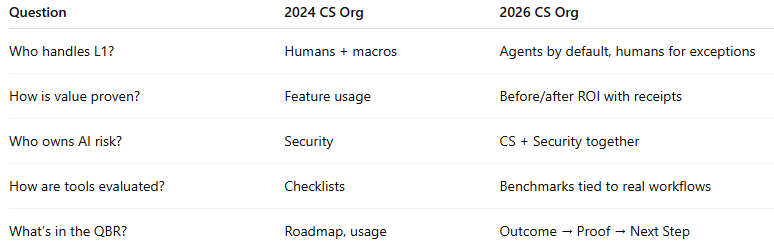
If you still look like the left column, you’re already behind.
Where the Real Work Starts
What Should Customer Success Leaders Do In the Next 90 Days?
This is where most CS teams fall apart.
Theory is free. Execution is what changes careers.
Everything below this point contains the exact 90-day AI roadmap, systems, templates, and governance workflows I use with CS teams.
It’s the part readers upgrade for.
🔒 The Exact 90-Day Roadmap for AI-Ready Customer Success Teams
If you want the pilot frameworks, metrics, QBR rewrites, playbooks, templates, and systems that top CS teams are building for 2026, unlock the full edition.
These are the same structures I use with leaders running $50M–$500M ARR CS orgs — and they’re all plug-and-play.