

The renewal does not get decided on the renewal call.
It gets decided in the 4 months before it, in signals most teams never write down.
By the time the renewal lands on the calendar, the outcome is mostly set. The call is where you find out.
Most CS teams run renewals as a Q4 scramble.
A list of accounts.
A round of one-off saves.
A few heroic recoveries that get celebrated and never turned into a system.
The team that saved a logo in week 50 had no system. They had luck and a good week.
Next quarter the same fire starts somewhere else, and the same people run at it with the same bucket.
A renewal is not an event. It is the last page of a motion that started four months earlier.
When that motion is missing, four failure points show up in order. Each one makes the next one worse.
This motion runs on a strong account plan. Build it with the account-level plan operating system that feeds these five stages.
Where Renewals Are Lost Before The Quote Opens
Ownership is fuzzy
Three people are “watching” the account. None of them owns the number.
The CSM thinks the AE has it.
The AE thinks the CSM has it.
The first person to truly own it does so at T-30, when owning it means triage rather than strategy.
Signals never get logged
The champion stops replying within a day. Usage holds flat while sentiment rots.
A workaround becomes the workflow, and the team stops complaining because they gave up expecting better.
None of this reaches the CRM. None of it reaches the forecast. The data says green.
The account is amber and falling.
The forecast is a feeling
“Probably fine” is not a forecast.
When Finance asks why an account sits at 80 percent, there is no scored answer, just a vibe and a hope.
Renewals that should have triggered a play in August get attention in November.
Value proof shows up late
The QBR runs as a status update instead of a decision.
The first time anyone assembles the ROI story is the week before the renewal, which is the one week there is no time left to close a gap the customer has been carrying for two quarters.
These four compound.
Fuzzy ownership => nobody catches the signal.
The missing signal => the forecast lies.
The lying forecast => value proof gets built too late.
By the renewal call you are negotiating from behind, and the customer can feel it.
The signals are there before the renewal is.
Read how dark accounts go quiet before they churn, why a customer workaround is a renewal signal, and how silent trust debt builds where nobody is looking.
A renewal you meet at T-14 is a renewal you hope for.
What Changes When Every Renewal Runs One Motion
Run every renewal through a single sequence and the quarter changes shape.
Risk surfaces at T-120, while you can still act on it.
Your forecast survives a CFO question, because every number traces back to a logged signal.
The renewal conversation becomes a confirmation of a story the customer already believes.
Saves stop being heroics and start being the output of a system anyone on the team can run.
Renewal season is already on the calendar.
The accounts that decide your number are sending signals today, while the quarter still has room in it.
The only open question is which accounts get the full motion and which ones you let ride.
That call is the whole game, and most teams make it at T-14 by accident.
Get The System That Runs This
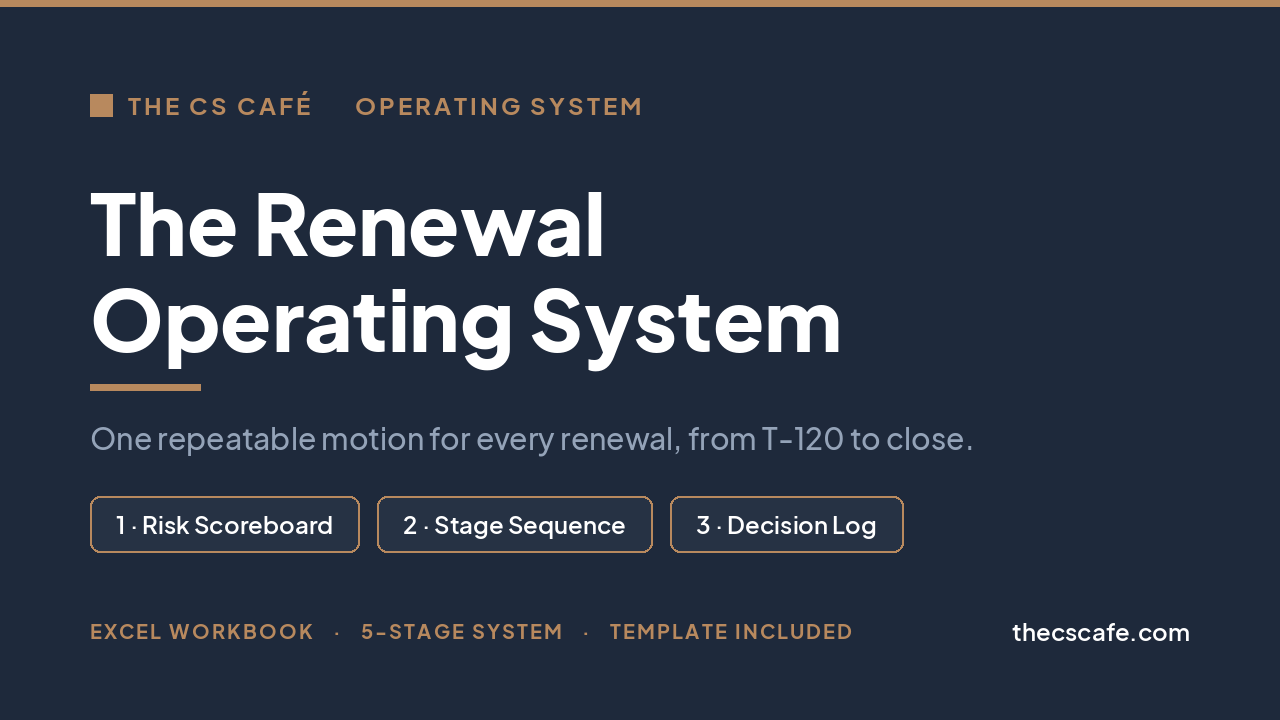
It runs on one tool: the Renewal Operating System workbook.
Two ways to get it. The subscription is the one to take.
Subscribe, $25/mo. This workbook, the full archive, and every system I publish next. Plus 24-hour replies when you need my feedback on a renewal, QBR, or exec update. → Upgrade
Standalone, $49. One download, no subscription. → Get the workbook
The first month of subscribing costs less than this workbook alone.