Welcome To CS My Way #9
Welcome to this exciting new space—CS My Way—where you can learn from the best in the industry and get ahead in Customer Success and beyond.
Each week, I engage in conversations with top executives — Chief Customer Officers, VP/Head of CS, founders, and CEOs. Together, we discuss how they drive success for their customers.
💡I always learn a lot from these exclusive interviews, packed with massive value, practical examples, key takeaways, and best practices from each leader.
I hope they’ll inspire you to build world-class CS organizations and accelerate your career in Customer Success and beyond.
💥I'm thrilled to bring you today my latest conversation with Kevin Herrholtz, Vice President of Customer Success at Minty (formerly AddShoppers), a leading digital commerce platform for brands and shoppers that save people time and money.

Thank you, Kevin, for sharing your story and insights with us on The CS Café!
The stage is yours!
P.S. Want to share your own story? Fill out this quick form and I’ll get back to you over email.
About You
You have a massive experience in the education field.
As an adjunct instructor at Bryant & Stratton College and in your consulting role at Client Success Central, how do you bring an educational perspective into client success? Are there principles from teaching that you find applicable in your current role?
My background is education which started as a middle school teacher for the first 7 years of my professional career.
I also have a Master’s degree in instructional design and I thought my initial journey would be building out a training curriculum for organizations.
I take that background and apply it to everything we do within client success.
There is a concept in education or training, known as the space learning effect.
With space learning you want to deliver material in small bite-size bits, but frequently over time.
Our whole training process is small achievable bits of information that are delivered in multiple mediums overtime.
This reinforces the foundational concepts that our clients need to get to the more challenging concepts.
That same approach is taken even during our QBRs.
We break them down into small segments. We don’t see it as a straight line, but rather as 10 mini segments with goals tied to them.
For me, it’s been the most natural path to go from K12 education to corporate education to customer success.
All of those elements make for a more comprehensive customer experience and journey.
About Customer Success
In your role as Vice President of Client Success, what specific strategies have you found most effective in ensuring the success of your clients at Minty?
All of our clients have success plans where we target their specific business outcomes and set benchmark KPIs that are time-based to ensure we consistently track them.
For our scaled clients, we utilized a one-to-many approach with a combination of asynchronous training, self-paced options, and weekly webinars to ensure we track toward their primary business goals.
Adapting to Diverse Client Needs
Minty serves a variety of eCommerce brands. How do you tailor your customer success approach to accommodate the unique needs and goals of such a diverse client base?
This is the reason for creating success plans with our clients.
The real challenge is our long tail of accounts. We have close to 1000 clients that fall into this cohort.
These clients receive surveys that capture their business outcomes.
As an organization, we know that there are three reasons why someone would want to adopt our technology. We have tailored scaled strategies that are geared to meet these primary objectives.
Balancing Automation and Personalization
With the advancements in technology, how do you find a balance between using automation for efficiency and maintaining a personalized approach to customer success interactions?
It's always people first, tech second.
Like most organizations, we practice high-touch customer success for our strategic clients where we have set QBRs and meet frequently.
However, we try to employ those same strategies in an automated way for our long tail of accounts.
We want to know the business outcomes of all of our clients.
Even if they are part of our long tail of accounts, we practice a pooled model where we still can meet with our clients on a requested basis to ensure they are making progress on and meeting the stated KPIs and goals within a specific time frame.
We also intervene with these clients if we see they are not making progress and hitting their objectives.
Handling Customer Feedback
Customer feedback is key for improvement. How do you actively collect and use feedback to improve the services and products offered by Minty?
Here’s how we do it in practice:
We have touchpoints throughout the customer journey.
We deploy satisfaction surveys after onboarding, once the software is fully deployed and anytime we release a new feature.
We treat negative feedback like a product bug.
The appropriate team(s) that is impacted by the feedback is mobilized to review the sentiment and appropriate action is taken.
The key internal SLA that we maintain is that all client feedback must be responded to the day the feedback was collected.
Measuring Success
In your role as VP of Client Success, what key metrics do you focus on to measure the success and health of your clients at Minty? How do these metrics guide your team in ensuring ongoing value for your clients?
The Northstar for us is Net Revenue Retention and logo churn.
The leading indicators that help us drive towards these goals are the performance in terms of revenue that we drive for the clients that we partner with.
At the beginning of our partnership, we meet with clients either 1:1 or a scaled approach to collect what their projected revenue goals are.
Our services are then set up to ensure we continuously strive towards these revenue goals.
We set up milestones and KPIs along the way that are mutually agreed upon with the client to ensure that we are making progress.
Key client milestones include how frequently shoppers are opening the emails we send and engaging with them.
We are just now building out our health scoring framework where we can drive CSM action if these time-bound milestones are not being met.
Client Onboarding and Tech Support
Your background includes roles in client onboarding and tech support. How do you ensure a seamless onboarding process for clients, and what role does tech support play in enhancing the overall client experience?
Every step in the onboarding process is carefully mapped out.
The number one thing that we want to do is deliver early value to our clients.
“Value 1” needs to be hit early to maintain momentum and squash fear or uncertainty around deploying our solution.
Our technical support team is not only very knowledgeable.
But we operate off of a service level agreement of responding to every submitted case within an hour and a half that it was received - Monday through Friday.
Speed is of the utmost importance as it shows that we are committed to our clients and we truly do care about their inquiries.
Balancing Long-Term Relationships with Short-Term Goals
In your role at Turning Technologies, you were Vice President of Customer Success and Solutions. How do you balance the need for achieving short-term goals with the importance of building long-term relationships with clients?
It was extremely important for us to educate our clients on a very complex software on what their path the maturity was.
We establish short-term goals with our clients that were achievable, and of course, time-bound.
We did this with:
a human-first approach by an always-on community to support our clients
an accessible customer support team
and a high-touch CSM approach.
We found out pretty early on that relationship strength, or lack thereof was one of the biggest predictors of churn.
We heavily partnered with our training and enablement teams to formulate a cohesive onboarding and implementation process that contained client checkpoints (meetings) along the way.
Impact of Technology on Client Success
With the rapid evolution of technology, how do you see emerging trends, such as AI and automation, impacting the field of client success? Are there specific technologies that you believe will play a critical role in the future of client success?
The role of technology will continue to become more prevalent.
This is a quite positive thing.
The challenge that we still have today is properly scaling customer success so that all clients receive a human-first experience that is supplemented with technology.
The world of digital customer success, or using in-app messaging, training, and community resources has revolutionized how we can work with many clients on a personalized level.
I still think there is progress that needs to be made and the role of technology will absolutely help us get there.
About Layoffs in Customer Success
Given the evolving landscape, many companies continue laying people off primarily their customer success positions. What's your take on it?
Customer Success can easily be viewed as an extension of support which can make it easier to justify cutting the position.
They cut the position because they viewed it as a cost center.
It needs to be the goal of the customer success team, to move beyond this first-wave approach and be seen as a revenue-driving entity within the organization.
That means that the teams need to be focused not only on retention but also on the growth of their current customer base.
The growth can come through upsells with additional licenses consumed or cross-sells where we can solve additional problems across the organization.
I see it as much more important to the leader of the customer success organization to make growth a priority, so they are not seen as an easily expendable part of the organization.
Personal Growth and Leadership
Throughout your career, you've held many leadership roles. How have you continued to evolve as a leader, and what advice would you give to professionals aspiring to reach executive levels in client success or related fields?
You have to be very committed to learning every day something new about your chosen field.
I still make it a point to read or watch webinars for at least 30 to 60 minutes every day.
I tell myself I need to consistently “fill the tank” with knowledge.
I had a mentor many years ago who told me this:
You will probably never come up with something that is brand new.
There are already others who are out there who have done it and done it very well.
You need to beg borrow and steal all the ideas that others have already perfected and make it work for yourself.
In addition, understand your business inside and out.
Understand other areas in the organization that you can positively impact.
Leadership is an action, with the title being awarded post-action.
Roll up your sleeves and contribute anywhere you positively can in your organization, and eventually will be recognized.
Personal Insights
What books or resources have had a significant impact on your thinking or approach to your career?
Extreme Ownership by Jocko Willink and Leif Babin is my leadership go-to book.
It’s a no-nonsense approach to leading a team and taking personal responsibility for every outcome.
The 7 Pillars of Customer Success by Wayne McColloch is my go-to CS book.
I “think” I’ve read them all and this is the only one that breaks information down into actionable steps. At least in my opinion.
Continuous Learning Sources
How do you stay updated on industry trends and best practices in your role? Are there specific blogs, podcasts, or newsletters you find particularly valuable?
I try to consume as much as possible.
I do enjoy the webinars produced by Client Success and Kristi Faltorusso, as well as Irit Eizips and her CS Practice YouTube channel.
I also enjoy what Jay Nathan has done with the Grow Gain Retain podcast series.
Leadership Philosophy
In your leadership roles, what principles or philosophies have guided your approach to building and leading successful teams?
I think it’s important to be empathetic to your team’s needs as human beings first.
Too often in corporate life, we become very robotic and less human-like.
We have to realize as leaders we are all human beings, and your team shows up every day with emotions, feelings, and thoughts.
It’s important to be caring as a human being first.
If you do, you’ll be amazed at the production you will get from your team.
Best Career Advice
Slow down and enjoy the process.
Earlier in my career, I was so hyper-focused on climbing the ranks.
Looking back, I wish I had taken more time to learn to better prepare myself as the promotions came.
Preferred Quote
“At the end of the day people won't remember what you said or did, they will remember how you made them feel.” ― Maya Angelou
Hobbies
Anytime with my family is a good time. I try to cherish those moments as much as possible.
And That’s It
I hope you enjoyed my conversation with Kevin as much as I did interviewing him!
Want to share your own story?
Fill out this quick form and I’ll get back to you over email.
I’ll speak to you in the next edition.
Cheers,
-Hakan.
COMING UP NEXT on CS MY WAY #10
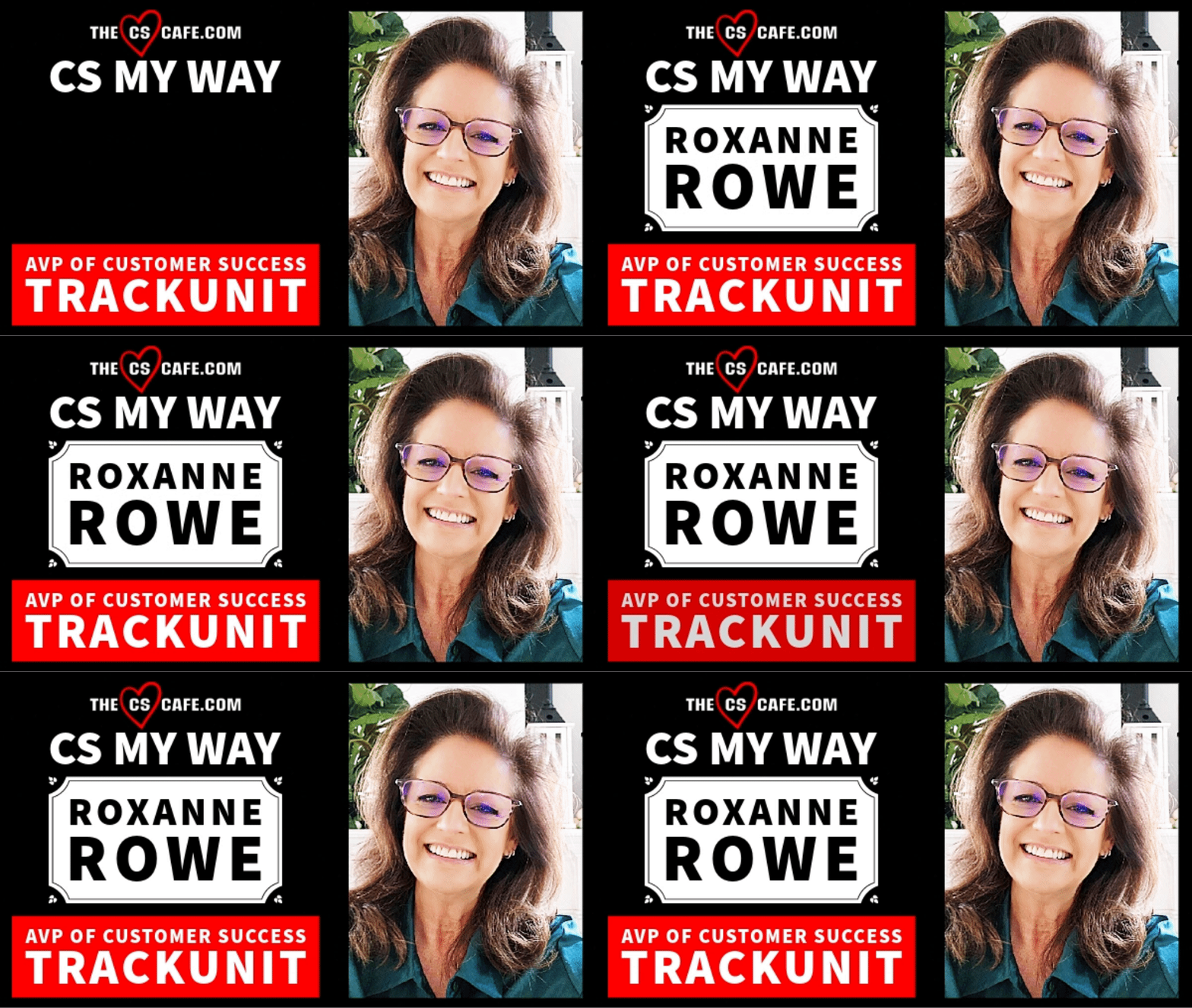
Roxanne Rowe, AVP of Customer Success at TrackUnit 🚀🚀
Level up your skills—Learn from the best leaders in the field with The CS Cafe Weekly Newsletter! 👀👀