

The 60-Minute QBR Agenda That Survives Exec Pushback
The reason most QBRs change nothing
Most QBRs end with the customer’s VP nodding politely while looking at her phone.
Two weeks later, the renewal conversation surfaces a blocker the CSM never heard about. The exec was never engaged. The meeting was a presentation, not a working session.
The agenda is the reason.
Build the QBR forward from the CSM’s deliverables and the meeting becomes a slide deck. Build it backward from the decisions the customer’s exec needs to make and the meeting becomes operational.
One produces nods. The other produces named owners with dates.
This post gives you the 60-minute agenda that works in real QBRs with real exec attendance.
Every section has a time block, an owner, and an outcome that must be reached before the next section starts.
There is a decision tree for when the exec walks in 20 minutes late.
There is a 48-hour prep checklist that runs in the background.
And there is a downloadable template at the bottom that you can clone into your own account.
The same structure works whether you run two QBRs a quarter or twenty.
It does not require Gainsight, Catalyst, or any specific platform. It requires that you stop running QBRs the way most CSMs do.
4 signs your QBR agenda is built backwards
If three of these are true on your last QBR, the agenda is the problem.
1. The agenda opens with metrics, not with the outcome the customer’s exec said matters last time
Adoption numbers, login counts, support ticket volume.
None of that is what the customer’s VP came to the meeting for. The opening section should restate the priority her exec team committed to.
Everything that follows is evidence against that priority. When the agenda opens with your data, the conversation never gets to her data.
The customer success plan you wrote at kickoff is the document that should open the meeting.
2. There is no decision required from the customer side. Just updates from yours.
A QBR with no decisions is a status report. Status reports do not need 60 minutes of exec time.
If the agenda has no row where the customer has to commit to something (a resource, a date, an expansion conversation, a sign-off), the exec will not show up next quarter.
3. The “next steps” section is owned entirely by your team.
If every action item starts with the name of someone on your side, the customer learned nothing new and committed to nothing.
A working QBR ends with at least one owned action on the customer side. Usually two. Sometimes three.
4. You don’t know who from the customer side is attending until the calendar invite.
The pre-read, the agenda, and the priority ordering all change depending on who shows up.
A VP-attended QBR runs differently than a director-attended one.
If you confirm attendees 48 hours out, half the prep work is wrong.
The 60-minute QBR agenda
This is the structure that survives real exec attendance.
Every row has a time block, an owner, and an outcome that has to be reached before the next section starts. Cut any section, the rest still works.
Run it long, the decision tree below tells you what to drop.
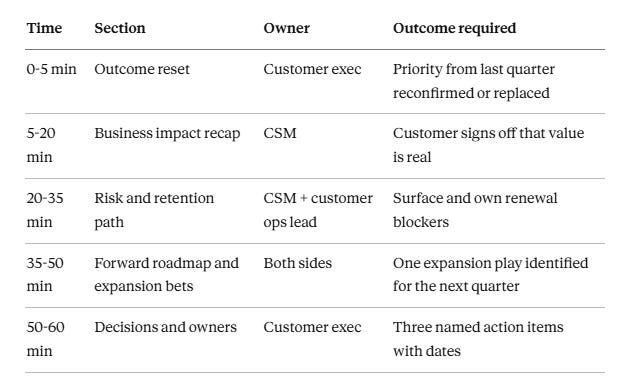
0-5 min: Outcome reset
The customer exec speaks first. The CSM asks one question.
“When we agreed last quarter that the priority was X, that was the outcome you needed your team to hit. Is X still the priority, or has something replaced it?”
The answer determines what gets emphasized in the next 55 minutes.
Most CSMs skip this step and walk into a meeting where they are reporting on the wrong priority.
5-20 min: Business impact recap
This is where adoption metrics, ROI math, and case examples earn their place.
Tie every data point back to the priority from minute 5.
If the priority is reducing time-to-resolution for support tickets, do not lead with seat utilization. The outcome required is that the customer exec signs off, verbally, that the value is real.
If she pushes back, the agenda pauses. Do not move on. The risk section below is where the pushback gets resolved.
20-35 min: Risk and retention path
The CSM walks through the account health scoring with the customer ops lead in the room.
Yellow flags and red flags get owned in real time.
The exec hears them once, in this section, with a recovery path attached to each one. No surprises in the renewal conversation later.
The outcome required is that every surfaced risk has a name and a date attached, on the customer side and on yours.
35-50 min: Forward roadmap and expansion bets
The CSM presents two or three expansion plays that map to the priority from minute 5.
Not a pricing pitch.
A capability or a use case that extends the value already proven.
The customer exec picks one. The other two go on the parking lot for next quarter. This is where net dollar retention gets earned.
The outcome required is one expansion play identified, with a discovery call scheduled before the QBR ends.
50-60 min: Decisions and owners
The customer exec restates the three things her team will do before next quarter.
The CSM restates the three things her team will do. Each one has a name and a date.
The CSM sends the recap email within 24 hours, with the same names and dates verbatim.
The “exec walks in 20 minutes late” decision tree
The agenda above assumes everyone shows up on time.
Real QBRs do not work that way. The customer’s VP gets pulled into something at 2:55. She joins at 3:18. Now you have 42 minutes, not 60.
Here is what gets cut, what gets compressed, and what survives.
Scenario 1: Exec joins 15 minutes late.
Cut the business impact recap to 5 minutes.
Send the full deck as a follow-up. Keep risk, expansion, and decisions at full length. The outcome reset is the only section that cannot be skipped.
Run it the moment the exec joins. Everything that happened before she arrived was prep, not the QBR.
Scenario 2: Exec joins 25 minutes late.
Drop the business impact recap entirely.
Send a one-page summary in the follow-up. Move directly from outcome reset to risk. Compress expansion to 10 minutes. Protect the decisions section.
Do not let the meeting end without the three owned actions on her side.
Scenario 3: Exec drops off after 30 minutes.
This is the most common failure mode and the one to plan for.
If she has to leave, the agenda must already be at the decisions section. That means risk and expansion get compressed into 10 minutes combined.
The decisions section is owed to her, not to her team. Ask her to stay for the last 5 minutes specifically.
The rule across all three scenarios. The decisions section is non-negotiable. Everything else is variable.
Vendor QBR vs internal QBR
A vendor QBR is the one most CSMs run. You are the vendor. Your team is presenting. The customer’s team is reviewing.
An internal QBR is the one the customer’s CS team runs about your account. You are the topic, not the host.
The agenda structure stays the same. Three things change.
In a vendor QBR, the outcome reset opens with the priority the customer’s exec set.
The CSM facilitates.
In an internal QBR, the customer’s CS team owns the outcome reset and the CSM listens. Adapt by being prepared to hear a different priority than the one you tracked.
In a vendor QBR, the risk section names blockers the CSM sees from the outside. In an internal QBR, the customer’s team names blockers the CSM may never have seen. Adapt by bringing the recovery path framework, not the diagnosis.
In a vendor QBR, the expansion section is led by the CSM.
In an internal QBR, the expansion section is led by the customer if it happens at all.
Adapt by being ready to drop expansion entirely and double the time on retention.
The 48-hour pre-QBR prep checklist
Most QBR failure happens before the meeting starts. Here is the prep that the agenda assumes.
48 hours before
Confirm attendees on the customer side by name and title.
The deck for a VP-attended QBR is different from the deck for a director-attended one. Send the pre-read. One page.
Three sections: the priority from last quarter, the headline metrics, the two open questions for the exec.
Pull the account health scoring and write the recovery paths for any yellow or red flags. The risk section in the meeting is for surfacing, not for diagnosis.
The diagnosis happens now.
Walk the deck with whoever owns the account commercially on your side. AE, sales manager, or RevOps lead.
If the account ratio means this is one of your top 10 accounts, the deck gets two walkthroughs.
24 hours before
Confirm pre-read was opened.
Most pre-reads are not opened. If the customer exec has not seen it, the outcome reset section is the only place to recover. Plan accordingly.
Pull the renewal timeline and any pricing decisions that need to surface in the next 90 days. The QBR is where pricing gets previewed, not where it gets sprung.
Print the agenda. Have it physically on the desk during the meeting. The agenda is the document that holds the meeting together when the exec joins late.
2 hours before
Re-read the priority from last quarter. Memorize the one sentence that opens the outcome reset.
Check your account notes for any commitments your team made last quarter that did not get delivered. Anticipate the question. Have the answer ready before the exec asks.
5 common QBR agenda mistakes
A short checklist before publishing the meeting invite.
The agenda has no decision required from the customer side.
Fix: add one row where the customer has to commit to something.
There is no time block for risks.
Fix: 15 minutes minimum, named owners on both sides.
The customer exec receives the deck 5 minutes before the meeting.
Fix: pre-read sent 48 hours out, confirmed opened 24 hours out.
No pre-read sent at all.
Fix: one page, three sections, sent before the calendar reminder fires.
The agenda runs more than 60 minutes.
Fix: cut the business impact recap before cutting anything else. The decisions section is non-negotiable.
Get the QBR template
The full QBR agenda template, the risk scoring tab, and the decisions tracker are bundled as a free download for newsletter subscribers.
The bundle includes:
The 60-minute agenda template with time blocks, owners, and outcome columns
A risk scoring tab that maps to the red/yellow/green health framework
A decisions tracker that pre-fills the recap email format
I publish a Customer Success operating system and a career-track post every week. Free to read, free to subscribe.
Hakan Ozturk | Founder, TheCScafe.com