

Last updated: March 2, 2026
Most CSMs have a RYG dashboard. Few use it to make actual decisions.
Red. Yellow. Green. Three colors. Infinite ways to get it wrong.
If your RYG scores aren’t directly tied to renewal conversations, escalation triggers, and boardroom-level reporting, you’re running a color-coding exercise, not a customer health system.
This guide gives you the full RYG framework: what it means, how to set the thresholds that actually predict churn, how to run the review, and the three mistakes that make most RYG systems useless.
What Does RYG Mean in Customer Success?
RYG stands for Red, Yellow, Green: a traffic-light health scoring system used by Customer Success teams to classify the status of every account in their portfolio.
Each color maps to a risk level and triggers a specific set of actions:
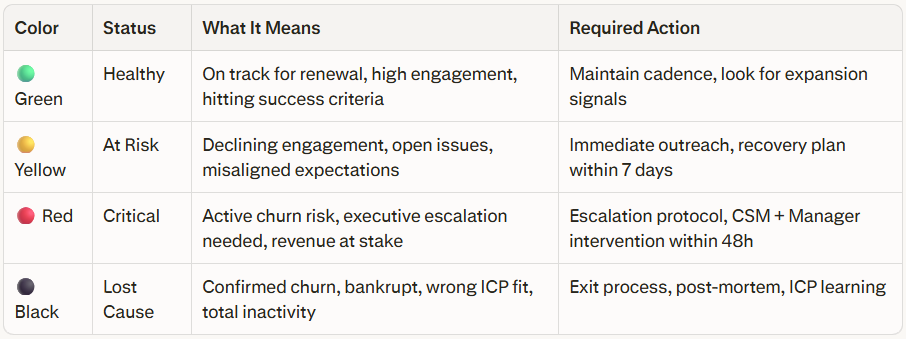
The Black category is used by mature CS teams to separate “save-able” reds from accounts that are genuinely unrecoverable so that your team doesn’t burn resources on lost causes.
Why RYG Scoring Fails Most CS Teams
The reality is that most RYG systems are subjective guesses dressed up as data.
A CSM feels good about an account → Green.
A renewal is coming up, and they’re nervous → Yellow.
The account just complained → Red.
This is opinion, not a system. And it creates three predictable failure modes:
1. Score inflation: CSMs over-report Green to avoid management scrutiny. Your portfolio looks healthy. Your renewal forecast is wrong. You find out on the renewal call.
2. Lagging signals: RYG scores that only update when something bad has already happened are post-mortem reports, not early warning systems. By the time an account goes Red, you may already have 60 days left.
3. No playbook attached: A score without a required action is decoration. If Yellow doesn’t automatically trigger a specific outreach sequence with a deadline, nothing changes.
The fix is to define RYG criteria in advance, as a team, using measurable signals, not how the CSM feels on a given Friday.
How to Set RYG Thresholds That Actually Predict Churn
The best RYG criteria combine three signal types:
Usage signals (product data)
Login frequency vs. baseline
Feature adoption rate (are they using the features tied to their success criteria?)
Seats active vs. seats purchased
Relationship signals (engagement data)
Last meaningful touchpoint (not just an auto-email)
Executive sponsor responsiveness
NPS score trend (not just score)
Support ticket volume and sentiment
Business signals (commercial data)
Days to renewal
Open commercial issues (price disputes, legal, pending contracts)
Customer’s own business health (funding, layoffs, M&A)
Practical threshold example for a SaaS B2B context:
🟢 Green: 80%+ of seats active, all success criteria on track, last touchpoint < 14 days, NPS 8–10, renewal > 90 days out
🟡 Yellow: 50–79% seat activity OR one open support issue OR last touchpoint > 21 days OR champion changed roles OR renewal 45–90 days out
🔴 Red: <50% seat activity OR active escalation OR champion gone with no replacement OR renewal < 45 days with unresolved issues OR NPS below 6
⚫ Black: Confirmed non-renewal OR company bankrupt/acquired OR account was never the right ICP fit
These thresholds are illustrative. Your team needs to calibrate them to your product, sales cycle, and churn data. But the principle is non-negotiable: every color must have objective, measurable criteria.
How to Run an RYG Review (The 15-Minute Weekly Format)
The RYG review is not a marathon meeting.
Done right, it’s a 15-minute weekly sync that keeps your entire portfolio visible without overwhelming the team.
Who attends: CSM team + CS Manager (optional: Sales for upsell signals)
Cadence: Weekly, same time, never skipped
Format:
Reds first (5 min)
Each Red account: What’s the status? What’s the action? Who owns it? What’s the deadline?
Yellow watch list (5 min)
Any Yellow accounts trending toward Red? Any that recovered to Green? Update the score, assign the action.
Green → Expansion flags (3 min)
Any Green accounts showing expansion signals (new use cases, seat growth requests, champion promotions)? Flag for Sales or CS-led upsell.
Score updates (2 min)
Lock in any score changes from the past week with a one-line reason logged in your CRM.
The one rule: Every score change must have a log entry. “Changed to Yellow because...” One sentence. This creates accountability, protects you in renewal conversations, and gives leadership a real-time portfolio view.
The Impact of RYG on Renewal Forecasting
This is where RYG goes from a CSM tool to a boardroom metric.
When your RYG scores are objective and consistently applied, you can do something powerful: calculate ARR at risk by color.
A CS leader who walks into a QBR and says, “We have $2.4M in Green ARR, $480K in Yellow with recovery plans in motion, and $120K in Red. Here’s the action plan for each Red account,” is speaking P&L language.
That’s the difference between CS being viewed as a cost center and CS being viewed as a revenue protection function.
To get there, you need your RYG system to be clean enough to trust.
Which means: objective criteria, consistent scoring, weekly reviews, and every score change documented.
Top 3 Mistakes to Avoid in Your RYG Reviews
Mistake 1: Reviewing accounts without a defined scope
Don’t try to review your entire 200-account book in one session.
Run RYG reviews by segment: enterprise accounts weekly, mid-market bi-weekly, SMB monthly. Scope matters. A broad, unfocused review produces nothing actionable.
Mistake 2: Skipping the “why” behind the score
A Yellow account with no context is useless.
Why is it Yellow? Missing champion? Low adoption? Upcoming renewal?
The reason determines the action. If your RYG tool doesn’t require a reason for every Red and Yellow, you’re flying blind.
Mistake 3: Letting CSMs score their own accounts without a check
Score inflation is real, and it’s not always intentional.
Build in a manager review step for all Red accounts and any account that changed from Red to Yellow in fewer than two weeks. Trust but verify.
Your RYG Cheat Sheet
Save this as your team’s scoring reference:
🟢 GREEN = Healthy
→ Success criteria on track
→ High engagement (80%+ active seats)
→ Sponsor responsive, NPS 8+
→ Action: Maintain cadence + watch for expansion
🟡 YELLOW = Watch
→ One or more risk signals present
→ Recovery plan required within 7 days
→ CSM-led action, escalate if no improvement in 14 days
🔴 RED = Escalate
→ Active churn risk
→ CS Manager + CSM joint ownership
→ 48-hour response required, written recovery plan
⚫ BLACK = Exit
→ Non-recoverable
→ Feed learnings back into ICP and onboarding criteria
My Key Takeaways
RYG is only as good as the criteria behind it.
Build objective, signal-based thresholds. Run weekly reviews with a defined format. Attach a required action to every color. Log every change.
Do that consistently for 90 days and you’ll have something most CS teams don’t: a portfolio you can actually trust, and a renewal forecast that doesn’t surprise you.
If you found this useful, join 4,300+ CS professionals who get proven frameworks, ready-to-use playbooks, and career-accelerating insights every week.