

Best Customer Success Platforms in 2026: Real Prices, Picked by Stage
Last Updated: Sep 28, 2026
Every platform in this guide is quote-based. Price ranges come from third-party buyer data and vendor materials as of Sep 28, 2026. Confirm during evaluation.
The platform you pick matters less than whether your team uses it by day 90. An unused platform returns close to zero, whatever the brand.
This guide ranks 8 platforms by the three things that decide payback: stage fit, Year-1 total cost of ownership, and day-90 adoption risk.
Pick by these three first. Compare features after.
Pick the Right Platform in 60 Seconds
Start from your stage and your biggest problem.
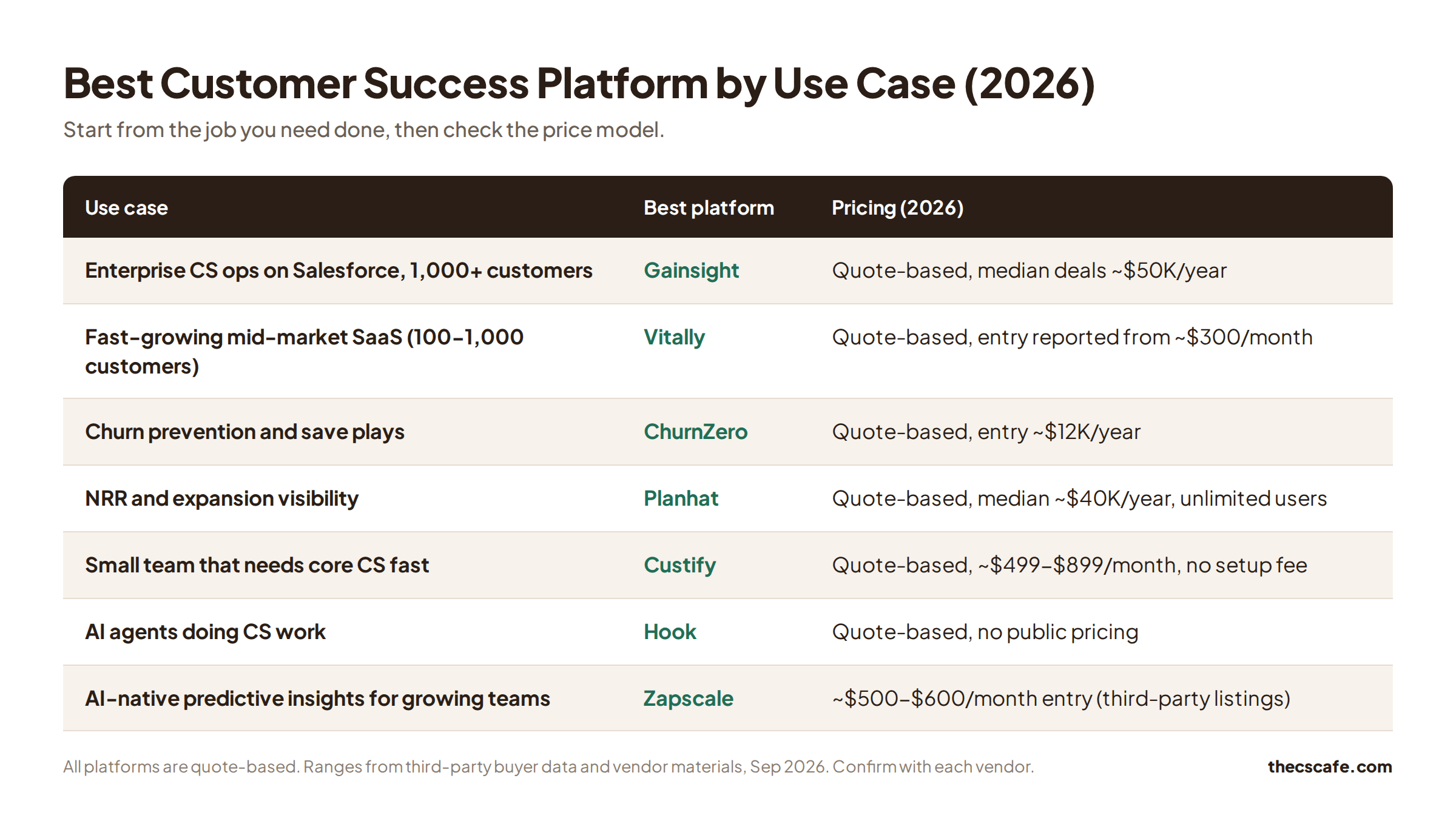
Salesforce-run, 1,000+ customers, mature CS Ops: Start with Gainsight.
Mid-market SaaS (100-1,000 customers) that needs speed and automation: Start with Vitally. For the full growing-team shortlist, see the growing SaaS guide.
Retention is the whole job (renewals, churn risk, save plays): Start with ChurnZero.
NRR and expansion visibility are the priority: Start with Planhat.
Small team that wants core CS fast: Start with Custify.
You want AI agents doing CSM work: Start with Hook, then read the AI-First section before you book demos. This category moves fastest and shows the widest gap between demo and day 90.
How This Guide Works
This guide is organized by stage. Each platform sits in the group it fits best: enterprise, mid-market, small teams, or AI-first.
What I weigh: integration depth, health-scoring flexibility, automation, exec reporting, time-to-value, and day-90 adoption risk.
Editorial promise: Vendors can buy a featured placement, clearly marked as sponsored. They cannot buy rankings, soft treatment, or conclusions.
A note on prices: none of these vendors publish list prices on their own sites. The ranges below come from third-party buyer data and vendor materials. Use them to budget and to test a quote, then get your own number.
What Good Customer Success Software Must Do in 2026
Get clear on the non-negotiables before you compare brands. The platform that wins your evaluation should do all seven.
1. Scalability
It supports your current base and the next 2-3 years of growth without a full re-implementation.
2. Integration Strength
It connects cleanly to your CRM, product analytics, billing, and support tools. A platform that can’t read your stack on day one won’t get used.
3. Signals and Analytics
It turns raw data into health scores, risk flags, and expansion visibility. Most teams run this as an RYG health scoring system (Red, Yellow, Green) with measurable thresholds for each color.
If CSMs still decide who’s at risk by gut feel, the platform isn’t doing its job.
4. Automation
It removes repetitive CSM work and enforces the same playbooks across the team. Automation is what lets coverage grow while headcount stays flat.
5. ROI Visibility
It shows leadership the revenue you protected and the churn you prevented. This is what earns CS a seat at the boardroom table.
6. Data Ownership
Every signal has one clear source of truth: CRM, product, billing, or support. When ownership is fuzzy, health scores turn into politics.
7. Agent Governance
This one is new for 2026. Many platforms now act on their own: drafting emails, sending outreach, updating the CRM. Every automated action needs an approval step, an audit log, and a named owner. Ask how the platform handles a wrong message sent to a strategic account.
Most CS platform failures trace back to fit. The tool was too complex for the team, underpowered for the data volume, or too hard to connect to the existing stack.
The 50-Point CS Platform Scorecard
Score each platform on your shortlist across five dimensions, 10 points each, for a total out of 50.
Under 35, pass. From 35 to 42, run a real proof of concept before signing. Above 42, run the procurement.
1. Stage Fit (10 Points)
Does the platform match your customer count, CS team size, and CS Ops maturity?
10: Built for your segment. Reference customers at your customer count run it well.
7: Adjacent segment. It works with effort, but it’s over- or under-featured for your stage.
4: Wrong segment. You’ll outgrow it within 12 months or never grow into it.
0: Wrong segment and wrong direction of travel.
2. Integration Depth (10 Points)
Native, pre-built connectors to your CRM, billing, product analytics, and support tools.
10: All four native, working on day one.
7: Three native, one needs API configuration.
4: Two or fewer native, custom development needed.
0: Custom build for your core CRM. Walk away.
3. Day-90 Adoption Risk (10 Points)
How likely is it that your CSMs use it daily by month three?
10: Implementation under 4 weeks. CSMs want to use the interface. Reference customers report over 80% daily usage by day 90.
7: 6-8 week implementation. Some CSM resistance expected. Strong admin tools.
4: 8-12 week implementation. Heavy admin overhead. Adoption depends on a dedicated CS Ops resource.
0: No clear path to daily CSM use. The platform becomes a dashboard nobody opens.
For AI-first platforms, score adoption on how often CSMs act on the AI’s recommendations as well as on logins. An agent whose output gets ignored carries the same risk as an unused dashboard.
4. Year-1 Total Cost of Ownership (10 Points)
Subscription plus implementation, training, integration work, and migration.
10: Year-1 TCO under 1.5x the annual subscription.
7: Year-1 TCO at 1.5-2x the annual subscription.
4: Year-1 TCO at 2-3x the annual subscription.
0: Year-1 TCO over 3x the annual subscription. The budget won’t survive.
5. Exec Reporting (10 Points)
ARR at risk, NRR by segment, and save-play results, all exportable for the boardroom.
10: Exec dashboards out of the box. The CFO and board see ARR by color in one click.
7: Exec views available with light customization.
4: CS Ops has to rebuild exec reporting by hand each quarter.
0: No exec reporting layer. You’ll keep building decks in Excel.
Run this scorecard on your top 3 platforms before you book demos. The scorecard sets the agenda. The demos test the highest scores in your environment, with your data.
Customer Success Platform Comparison 2026
Best Customer Success Software by Company Size
Enterprise (1,000+ customers)
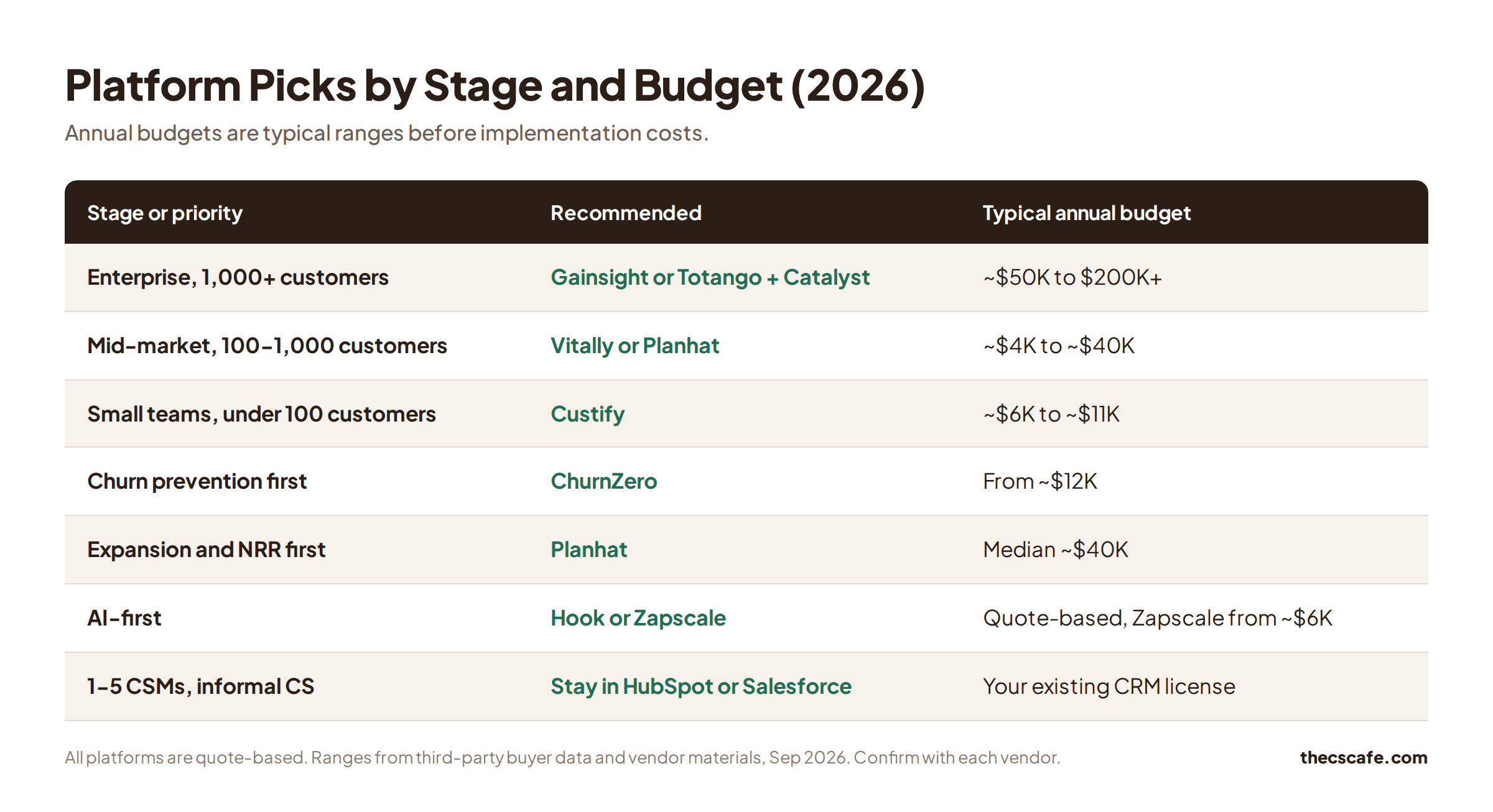
Gainsight: Full-featured, strongest Salesforce-native footprint. Quote-based, median deals around $50K/year
Totango + Catalyst: Advanced AI, strong for high-growth companies. Quote-based
ChurnZero: Churn prevention specialist, now with AI agents. Quote-based, entry around $12K/year
Mid-Market (100-1,000 customers)
Vitally: Modern design, full feature set on every plan. Quote-based, entry deals reported from around $300/month
Planhat: Revenue and expansion focus, unlimited users. Quote-based, median around $40K/year
Small Teams (under 100 customers)
Custify: Easy to deploy, essential CS metrics, no setup fee. Quote-based, around $499-$899/month
AI-First
Hook: AI agents that analyze every touchpoint and can execute plays across a CS segment. Quote-based
Zapscale: AI-native portfolio intelligence for growing teams. Third-party listings show entry around $500-$600/month
AI-first platforms built for books above 100 customers are being evaluated for the next edition. For newer tools not yet ranked here, see the Emerging Customer Success Tools page (sponsored listings, reviewed for fit).
The 6-Question Decision Tree
Answer these yes/no questions in order, and stop at the first routing.
Q1. Is your whole revenue org on Salesforce, with 1,000+ customers and a dedicated CS Ops function?
Yes → Gainsight. Salesforce-native depth is non-negotiable at this scale.
No → Continue to Q2.
Q2. Is churn detection and save-play execution your single biggest problem, ahead of expansion or onboarding?
Yes → ChurnZero. It’s built with retention as the primary job.
No → Continue to Q3.
Q3. Is your CS team measured on NRR, with expansion as a primary mandate?
Yes → Planhat. Revenue visibility is its core architecture.
No → Continue to Q4.
Q4. Are you mid-market (100-1,000 customers), scaling while holding headcount flat, and need to be live fast?
Yes → Vitally. Faster than average go-live, modern automation, designed for scaled CS.
No → Continue to Q5.
Q5. Do you want AI to act on accounts (prioritizing work, drafting outreach, updating the CRM)?
Yes, inside a full CS platform → Gainsight, Totango + Catalyst, or ChurnZero. Run a proof of concept on your own data before you trust the output.
Yes, as the core of the platform → Hook. Double the weight on Day-90 Adoption Risk and check agent governance before signing.
No → Continue to Q6.
Q6. Do you have under 100 customers and limited CS Ops resource?
Yes, and you want predictive signals first → Zapscale or Hook. Test on your own data before committing.
Yes, and you want core CS fast → Custify. The no-drama choice.
No to both → Either you’re pre-platform (stay in your CRM) or you skipped a Q1-Q5 answer. Run the tree again.
The tree gives you a starting point. Before you sign, run the 50-point scorecard on your routed platform plus one alternative.
Top Customer Success Platforms: Detailed Reviews
1. Gainsight: Enterprise-Grade CS Management
Best for: Large enterprises with complex CS operations Pricing: Quote-based. Median deals around $50K/year, with enterprise contracts running past $200K Trial: Demo available
Gainsight is the market reference for enterprise CS. It’s the usual default when Salesforce is the system of record and you need CS-specific workflows.
Key capabilities:
360° health monitoring with customizable scoring
Predictive churn analytics
Enterprise-grade security and compliance
Native Salesforce integration, widely considered best-in-class
Your results depend on adoption, data quality, and whether save plays get run once alerts fire.
Honest limitation: Gainsight is powerful and complex. Implementation often takes 8 weeks or longer and needs dedicated resources, and services are quoted on top of the license. It suits large, mature CS organizations. Teams that need to be live in weeks should look elsewhere.
2. Vitally: The Modern Platform for Fast-Growing Teams
Best for: Growing SaaS companies (100-1,000 customers) Pricing: Quote-based across three plans (Tech-Touch, Hybrid-Touch, High-Touch). Entry deals reported from around $300/month Trial: Sandbox with your own data after a demo
Vitally is the platform I point most mid-market teams to first. It pairs strong automation with an interface teams like to use, and every plan includes the full feature set.
Vitally’s own G2 data puts average go-live at 1.9 months, against a category average of 2.6 months.
It works especially well for teams scaling from 100 to 1,000 customers with pooled or scaled CS models.
Standout features:
AI-powered health scoring and account summaries
Unlimited automations on every plan
Real-time analytics dashboard
Faster than average go-live
Vitally vs. Gainsight: When to Choose Which
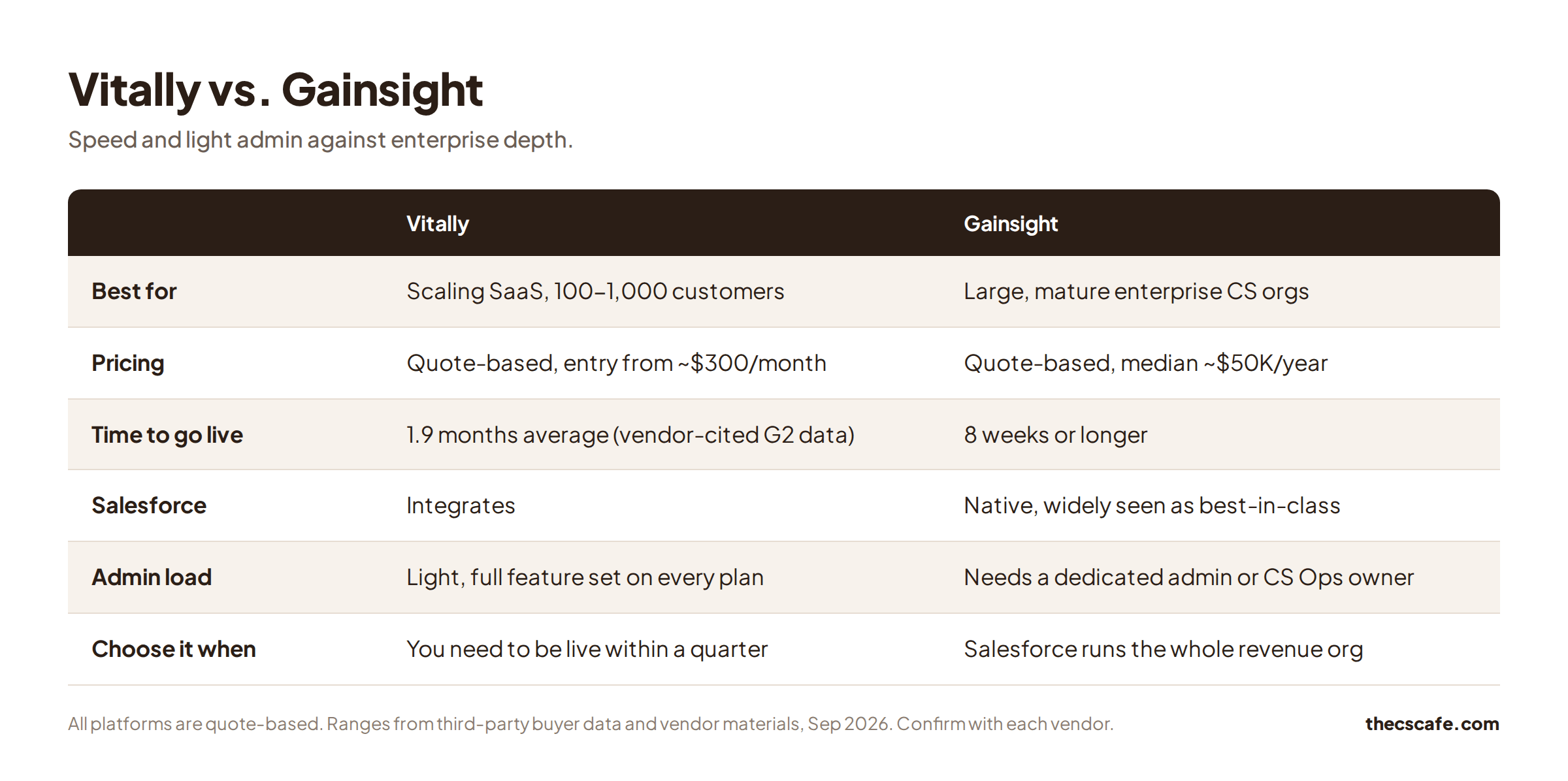
Choose Vitally if:
You need to be live within a quarter
You’re growing coverage while holding headcount flat
You want strong workflows with light admin overhead
Choose Gainsight if:
You run complex enterprise motions and need deep customization
Salesforce is the system of record for the whole revenue org
You have CS Ops resources to own the platform long term
If you’re a growing team weighing the whole category, the growing SaaS software guide compares Vitally with the other growing-team tools in depth.
3. ChurnZero: Churn Prevention Specialist
Best for: Retention-focused CS teams Pricing: Quote-based, priced on accounts managed plus CSM seats. Entry around $12K/year
ChurnZero does one job exceptionally well: catching churn early. Its ChurnScore engine is the most configurable health score outside Gainsight.
It now adds AI agents that flag risk and opportunity early and recommend the next action.
When an account does churn, ChurnZero leaves the data trail you need for a proper post-mortem, so the lessons feed back into your ICP.
Platform highlights:
Real-time health monitoring
Customizable ChurnScore algorithm
AI agents for risk and next-best action
In-app engagement tools
Native revenue tracking
ChurnZero vs. Gainsight
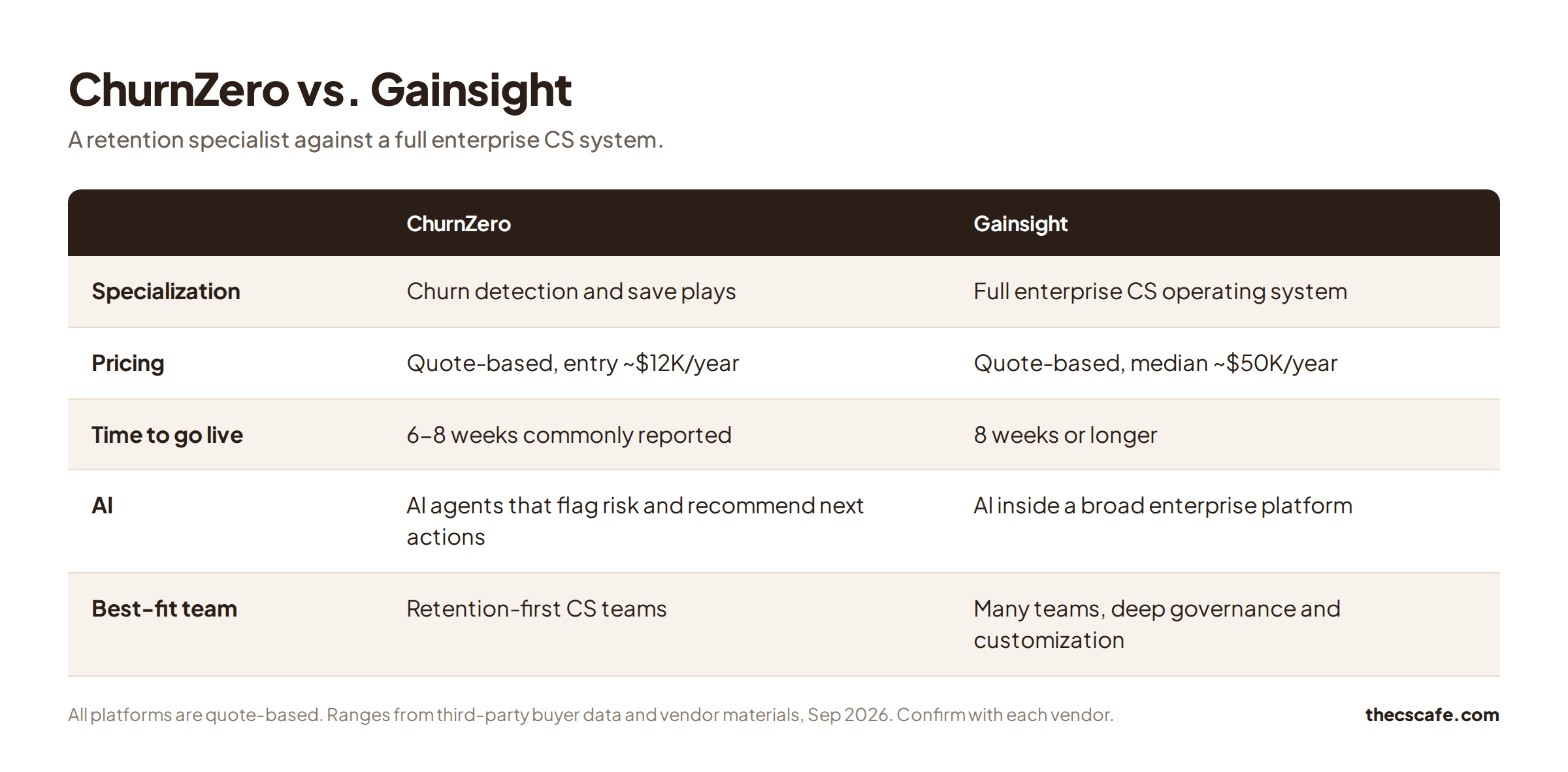
Choose ChurnZero if:
Your main problem is churn detection and save plays
You want a retention-first engine that’s easier to run day to day
Choose Gainsight if:
You need broader enterprise workflows across many teams
You need deep governance, customization, and scale controls
4. Planhat: Revenue Optimization for B2B SaaS
Best for: B2B SaaS companies focused on expansion revenue Pricing: Quote-based, priced on customer accounts with unlimited users. Median around $40K/year
Planhat is the choice when NRR is the primary metric. It’s built around revenue visibility, with a flexible data model and a custom reporting engine few platforms match.
If your CS team owns Net Revenue Retention on top of renewals, Planhat gives you the clearest view of where expansion lives and where it’s at risk.
Key differentiators:
Revenue and expansion tracking
Custom reporting engine
Advanced workflow automation
Unlimited users, so sales and support can work in it without seat costs
It pairs well with a dedicated NPS survey tool when you want sentiment and behavior in one health view.
5. Totango + Catalyst: The Merged CS Powerhouse
Best for: High-growth SaaS companies Pricing: Quote-based
The merged platform offers no-code workflow automation, AI-driven customer insights, and fast time to value. Catalyst is now part of Totango, so confirm the current product name and packaging during evaluation.
It’s a strong choice for teams that want Gainsight-level depth with less complexity.
6. Hook: AI Agents for Customer Success
Best for: Teams that want AI agents at the center of CS, from small books to scaled segments Pricing: Quote-based, with no public pricing page
Hook has moved from predictive analytics to AI agents that act. Its agents read product usage, meetings, and support data, predict renewals and expansions, and can execute plays automatically, so a whole CS segment can run through Hook.
Hook vs. Gainsight on AI
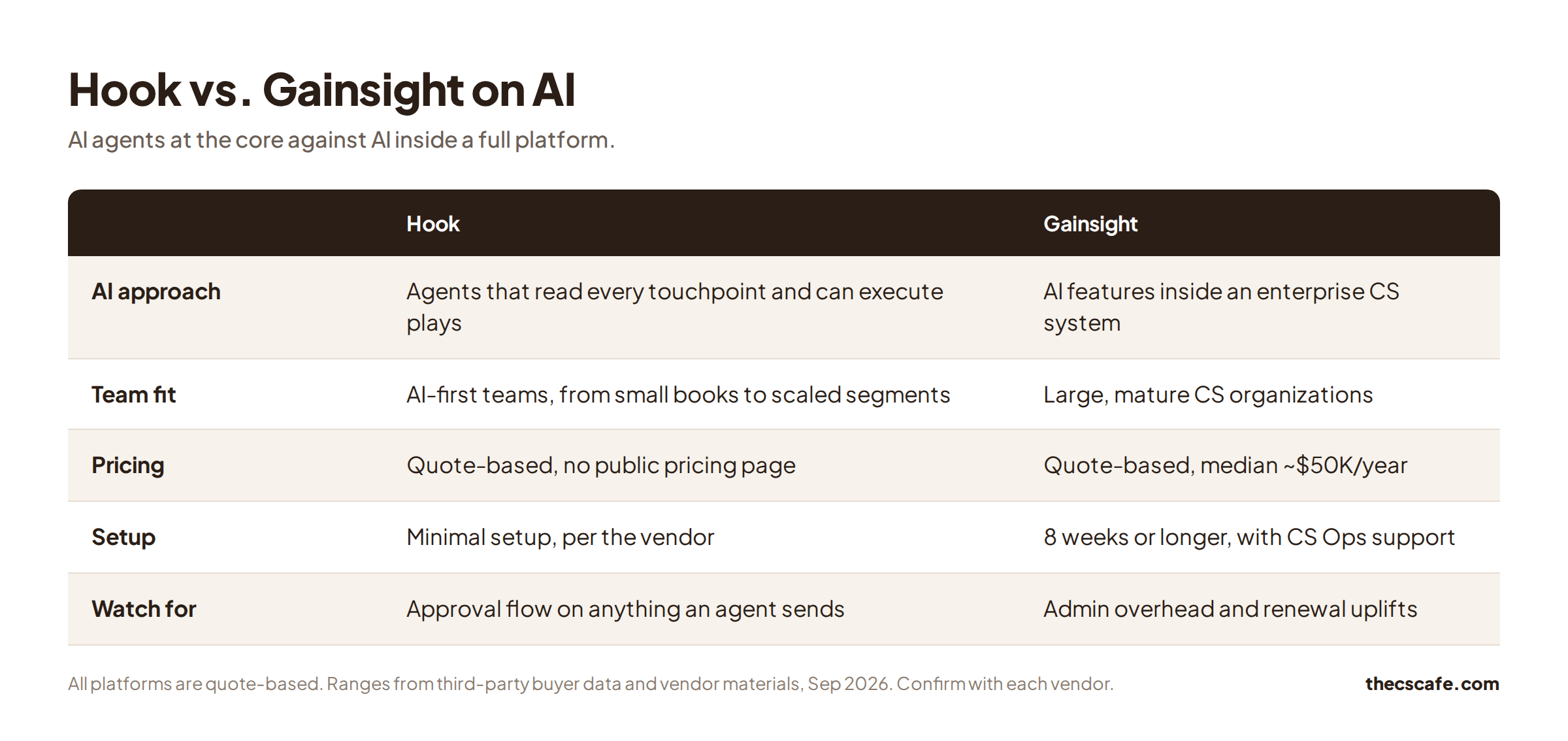
Choose Hook if:
You want AI agents doing the work, with minimal setup
You’re ready to put governance around automated customer touches
Choose Gainsight if:
You need AI inside a full enterprise CS operating system
Workflows and reporting matter as much as prediction
Honest limitation: pricing is sales-led only. Ask for reference customers at your customer count and for the approval flow on anything an agent sends.
7. Custify: The Practical Choice for Small Teams
Best for: Small to mid-size B2B companies Pricing: Quote-based, priced per CSM seat. Around $499-$899/month for a small team, with no setup fee
Custify is the no-drama option for teams that need core CS fast.
It offers concierge onboarding that gets you started in about 4 weeks, automated customer touchpoints, a friendly interface, and essential health metrics. Its strength is speed to value, and depth comes second.
8. Zapscale: Emerging AI-First Player
Best for: Growing teams evaluating AI-native CS platforms Pricing: Third-party listings show an entry plan around $500-$600/month for up to 100 customers. Confirm with the vendor
Zapscale focuses on predictive analytics and portfolio intelligence for growing CS teams.
Choose Zapscale if:
You want an AI-native platform over a traditional CS suite with added AI
You can run a proof of concept on your own data before committing
As with any newer vendor, ask for reference customers at your customer count.
Gainsight vs. HubSpot vs. Salesforce: Which to Use If You’re Already in a CRM
CS leaders at companies with an existing CRM investment ask me this more than anything else.
Use Gainsight (native Salesforce add-on) if:
Your entire revenue org runs on Salesforce
You need CS-specific workflows your CRM can’t support
You have the budget and implementation capacity
Use HubSpot CS Hub if:
You’re mid-market and already run marketing and sales on HubSpot
You want CS and CRM in one platform with no separate integration
Budget is a real constraint, since HubSpot costs significantly less than Gainsight
Stay in your native CRM (Salesforce or HubSpot) if:
Your CS team is small (1-5 CSMs) and accounts are manageable by hand
You’re pre-product-market fit and CS is still informal
You don’t yet track health scores, playbooks, or portfolio ARR at risk
Once any of those three answers flips, it’s time for a dedicated platform.
How to Choose the Right Customer Success Platform: 3-Step Framework
Step 1: Match to Your Stage
Step 2: Calculate True Cost of Ownership
Most CS leaders look only at the subscription price. The real cost includes:
Base subscription
Implementation fees (zero at some vendors, $10,000+ at most, far more for enterprise suites)
Team training time (1-2 weeks minimum)
Additional user licenses
Integration work with CRM, billing, and product analytics
Data migration (1-4 weeks, often the longest phase)
Annual uplifts at renewal, commonly 5-8% at enterprise vendors
Illustration: a platform at $499/month with a $10,000 implementation fee costs about $16K in year one. That’s roughly 2.7x the $6K subscription, which scores a 4 on the TCO line of the scorecard.
Want the model pre-built? The CS Platform Buyer’s Kit includes a 3-year TCO calculator, NRR-lift ROI at three scenarios, and a one-page exec summary that pulls live from the cost model. It’s built for the CFO meeting that comes next.
Step 3: Validate Before You Sign
Do all three before you buy:
Request a live demo with your own data. Canned demo environments hide integration gaps.
Speak with a reference customer at your company size. A mid-market team learns little from a Fortune 500 logo.
Run a real integration test. Connect your CRM and confirm the data flows correctly before signing.
Run the Full Procurement Without Buyer’s Remorse
The 3-step framework above is the operating system. The CS Platform Buyer’s Kit gives you the working files.
It includes an Excel workbook with the scoring matrix, a 40-question RFP bank, a demo scorecard, a reference check script, the full TCO model with NRR-lift ROI, and a one-page exec summary a CFO will actually read.
14 platforms pre-loaded. A 13-page PDF playbook with 10 chapters and 4 email templates. $79 for a single procurement, yours to keep.
→ Get the CS Platform Buyer’s Kit
Customer Success Platform ROI: What Drives It
Adoption in the first 90 days predicts ROI better than vendor choice. Three factors decide whether a platform pays back:
Adoption by day 90. CSMs who work in the platform daily generate the signals that make it useful.
Data quality and signal ownership. Health-score accuracy can only be as good as the data feeding it.
Save plays with an owner and a timeline. An alert with no owner protects nothing.
Load a clean retention health score into your platform from week one, with signal-based thresholds every CSM applies the same way. Without that foundation, even the best platform produces unreliable data.
Once your scores are clean, take them into your QBR. ARR by color then becomes a boardroom metric.
Integration Complexity Matrix
Ask how clean the data is on day one. A yes to “does it integrate?” tells you little.
Rate each connection in your own stack:
CRM (Salesforce/HubSpot): contacts, accounts, renewals, opportunity fields
Billing (Stripe/Chargebee): plan, invoice status, renewal dates, ARR
Product data (Segment/warehouse): usage events, feature adoption, logins
Support (Zendesk/Intercom): ticket volume, severity, response time
Data warehouse (Snowflake/BigQuery): history, joins, reporting speed
If any one of these needs custom work, a fast implementation becomes a quarter.
[Image: integration matrix, updated to cover all 8 platforms]
Legend: ✅ Native/pre-built | 🔧 API configuration required | ⚠️ Custom development needed | ⚡ Basic/limited
For more CS frameworks, research, and community resources, the Customer Success Association (customersuccessassociation.com) is the reference library trusted by CS professionals worldwide.
Industry-Specific Recommendations
For SaaS Companies: Key Requirements
Subscription lifecycle management, product usage analytics, automated renewal workflows, billing integration (Stripe, Chargebee), and cohort analysis.
SaaS CS leaders often underestimate how price increases interact with health scores. A price increase on a Yellow account calls for a different playbook than one on a Green account.
Best choices: Gainsight (enterprise), Vitally or ChurnZero (mid-market), Custify or Zapscale (early stage).
For Non-SaaS Companies: Key Requirements
Relationship management weighted above product usage, project milestone tracking, and custom engagement workflows.
Best choices: Gainsight or Totango + Catalyst (enterprise), Planhat (mid-market), Custify (small teams).
Frequently Asked Questions
Which Customer Success Platform Is Best for Startups and Growing Teams?
Growing and early-stage teams build their shortlist around speed to live, cost, and adoption. The short version: Custify for early stage, Vitally for scaling mid-market. The growing SaaS guide covers the full comparison.
How Much Does Customer Success Software Cost in 2026?
Every major platform is quote-based. Entry deals start at a few hundred dollars a month for small teams, mid-market deals typically land between $12K and $50K a year, and enterprise Gainsight contracts can pass $200K. Budget year one at 1.5-3x the subscription once implementation is included.
Why Don’t CS Platforms Publish Prices?
They price on your customer accounts, CSM seats, modules, and contract length, so every quote is different. Use third-party ranges to set a budget, then bring a competing quote to the negotiation.
What ROI Should I Expect From a Customer Success Platform?
Teams that fully deploy and operationalize a platform often see meaningful churn improvement within 6-12 months. The deciding factor is proper implementation.
How Long Does CSP Implementation Take?
Custify: about 4 weeks with concierge onboarding
Vitally: under 2 months on average, per its own G2 data
ChurnZero: 6-8 weeks is commonly reported
Gainsight: 8 weeks to several months
Data migration is usually the longest phase, whatever the platform.
Which Platform Has the Best Salesforce Integration?
Gainsight, followed by Totango + Catalyst. If your whole revenue org runs on Salesforce and you can’t add a separate integration layer, Gainsight is the only serious option.
Should I Use a Dedicated CS Platform or Stay in HubSpot or Salesforce?
With fewer than 5 people on the CS team and under 100 accounts, staying in your CRM is defensible. Above that, a dedicated platform usually pays for itself within 6 months in CSM efficiency and earlier warning signals.
Are AI Agents Ready to Run Customer Success Work?
They’re ready for parts of it: account prioritization, meeting notes, CRM updates, and first drafts of outreach. Keep a human approval step on anything a customer sees. Score AI platforms on agent governance and on how often CSMs act on the output.
What’s New in CS Platforms for 2026?
AI agents moved from add-on to core. Hook, ChurnZero, and Vitally all ship AI that summarizes accounts, flags risk, or acts on it. The gap between Gainsight and the rest of the market has narrowed significantly, and pricing has stayed quote-based across the category.
Two Ways to Take This Further
You came here to pick a platform, and the decision is in front of you. People usually take one of two paths from here.
Buy the Kit (For This Procurement)
This is for the CS leader running one platform decision who wants the working files today.
The CS Platform Buyer’s Kit: an Excel workbook with the scoring matrix, RFP bank, demo scorecard, reference check, and full TCO model, plus a 13-page PDF playbook with 10 chapters and 4 email templates. 14 platforms named. $79, one-time, yours to keep.
→ Get the CS Platform Buyer’s Kit
Join the Newsletter (For the Whole CS Practice)
This is for the CS leader who runs the whole function and wants new operating systems as they come out.
The CS Café publishes one every week: renewal plays, QBR cadences, exec dashboards, and expansion frameworks. It’s free to join. Paid subscribers get every workbook and resource included in the membership.
Deployment after you sign is its own project. Health score thresholds, QBR storylines, exec reporting, and renewal workflows are bundled in the Ultimate CS Templates Collection.
For Vendors: How to Be Considered for Future Editions
I update this guide as the market changes. New platforms enter, and existing players improve or stall.
If you run a customer success platform and want to be featured in a future edition:
Review the Vendor Inclusion & Platform Partnerships page.
Email hakan@thecscafe.com with your company name, what the product does, your ICP and segment, starting pricing, public proof points (G2 rating, customer results), and whether you’re interested in a featured placement, sponsorship, or both.
Earlier-stage tool? Start with the Emerging Customer Success Tools feature: two sponsored newsletter listings plus 90 days on the page.
Featured placements are paid and clearly marked as sponsored. They are written in my own voice from your product materials, and they don’t change how other platforms in this guide are presented.
That’s what keeps this guide useful for the 4,400+ CS leaders who rely on The CS Café for real decisions about their stack.
Hakan, Founder of The CS Café