

Last Updated: March 2, 2026
Applying for this Microsoft role?
Most applications for competitive roles like this get rejected by software before humans see them. WowThisCV shows you exactly what ATS platforms are looking for → Optimize your CV in 30 seconds at WowThisCV.com
Microsoft’s Customer Success Account Manager (CSAM) role pays $120K–$200K+ and gives CS pros a seat at the strategic table with enterprise customers.
This guide covers everything: what the CSAM role actually does, how it differs from a traditional CSM, the full salary breakdown by Microsoft level, the tools CSAMs use daily, and exactly how to land the role in 2026.
Want the full breakdown in one document? Download the Microsoft CSAM Playbook (PDF): free when you subscribe.
✅ Salary ladders by level
✅ 25 real interview questions with winning answers
✅ Compensation negotiation email scripts
What’s New for Microsoft CSAMs in 2026
Three things have changed since last year that matter before you apply:
1. Copilot adoption is now a core CSAM metric.
Microsoft is actively measuring CSAM performance on Copilot deployment and consumption across enterprise accounts. If you don’t have an AI adoption story in your interview prep, you’re behind every candidate who does.
2. The hiring bar has raised for AI fluency.
Candidates who speak to agentic workflows, Azure AI Studio, and responsible AI governance are advancing faster through interviews than those with traditional CS backgrounds alone.
3. Compensation has shifted upward at senior levels.
Level 64+ RSU grants have increased in line with Microsoft’s stock performance. Total compensation at L64 now commonly exceeds $250K in high-cost markets like Seattle and San Francisco.
What Does CSAM Mean at Microsoft?
CSAM stands for Customer Success Account Manager: Microsoft’s senior-level CS role responsible for driving technology adoption, consumption growth, and business outcomes for enterprise customers.
Unlike a standard CSM, a Microsoft CSAM is a strategic orchestrator who coordinates engineering, sales, product, and support teams on behalf of the customer. The role pays $120K–$200K+ and sits at Microsoft internal levels 60–65+.
If you’re searching “csam meaning microsoft”, this is it. It is not a cybersecurity role (that’s a different CSAM acronym). In Microsoft’s context, CSAM is exclusively the Customer Success Account Manager designation.
Microsoft CSAM vs. Traditional CSM: Key Differences
This is the question I get most from CS professionals exploring the role. Here’s the honest side-by-side:
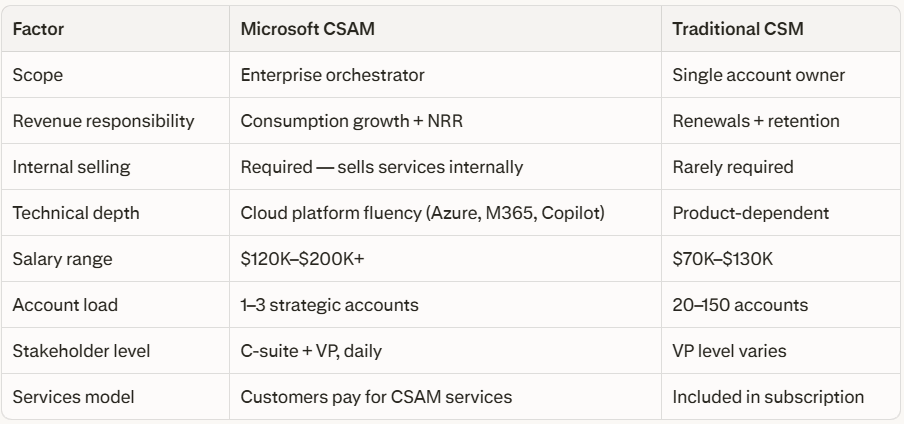
The core difference: a Microsoft CSAM runs toward complexity. Where a traditional CSM manages a relationship, a CSAM orchestrates an ecosystem (internal teams, partner networks, technical architects, and executive sponsors) all simultaneously.
This dual focus on outcomes and revenue is why the compensation for CSAMs significantly outpaces standard CSM roles across every experience level.
What Makes Microsoft CSAMs Different
There are CSMs. And then there are CSAMs, Microsoft style.
Microsoft’s Customer Success Account Manager is a strategic orchestrator committed to driving customer outcomes at scale. After talking to several current CSAMs, here’s what the role actually entails:
Core Responsibilities:
Cross-functional orchestration: Coordinating engineering, sales, product, and support teams to deliver the right resources at the right time
Technology adoption leadership: Helping enterprise customers implement Azure, M365, Security, and Copilot to achieve measurable business outcomes
Strategic advisory: Offering executive-level guidance to maximize ROI on Microsoft investments
Crisis management: Acting as the first responder during critical situations like cyber attacks, bringing in specialized Microsoft teams immediately
Consumption growth: Driving production-level usage and revenue expansion across cloud platforms
In short, CSAMs are the strategic glue between Microsoft’s capabilities and customer success, one of the most valued partners both internally and externally.
Day in the Life of a Microsoft CSAM
A typical day for a Microsoft CSAM balances customer strategy with internal coordination:
8:30 AM Strategic Account Review
“I review my customer health dashboard and notice one of my enterprise clients shows declining usage in a key product area. I immediately scheduled a call with their team lead to discuss potential barriers.” — Microsoft CSAM
9:00 AM – 12:00 PM Customer Engagement
Conduct virtual or on-site meetings with C-level stakeholders to discuss progress, address concerns, and identify expansion opportunities
Deliver strategic account reviews showcasing adoption metrics and ROI
Run executive briefings on new Microsoft capabilities (AI, Copilot, security features)
12:00 PM – 2:00 PM Internal Collaboration
Coordinate with sales teams and technology strategists to align on customer priorities
Partner with product specialists and engineers to architect solutions
Sync with support teams on escalated technical issues
2:00 PM – 4:00 PM Strategic Planning
Develop and refine Customer Success Plans (CSPs) focused on consumption growth and NRR
Analyze usage data and prepare reports on adoption rates and value realization
Build business cases for upsell and cross-sell opportunities
4:00 PM – 5:00 PM Problem Resolution & Learning
Address escalated issues with technical teams
Stay current on new Microsoft products, AI capabilities, and industry trends through Microsoft Learn
Participate in CSAM community sessions and best practice sharing
5:00 PM Wrap-Up
Update action items in Dynamics 365
Plan next day’s priorities
Review upcoming milestones and customer health signals
The Customer Advocate Role
As a CSAM, your primary job is to be the voice of the customer within Microsoft. You work closely with sales and engineering to ensure customers have what they need to succeed; it’s deeply collaborative.
Technical expertise helps, but isn’t mandatory.
What you absolutely need is exceptional organizational skills and the ability to communicate effectively at all levels, from technical engineers to C-suite executives.
As one CSAM told me: “You don’t need to be the most technical person in the room. You need to be the person who can translate technical capabilities into business value and orchestrate the right experts at the right time.”
Key Skills and Competencies for Microsoft CSAMs
Strategic Relationship Management: Building and maintaining strong relationships with customers, internal teams, and executive stakeholders is non-negotiable. You’re managing portfolios worth millions in ARR.
Business Acumen: Understanding how enterprise technology investments impact business processes, revenue, and efficiency. You need to speak the language of ROI, TCO, and business outcomes, not just features.
Strategic Thinking: CSAMs think several quarters ahead about how Microsoft’s solutions can address evolving customer needs and drive transformation.
Advanced Problem-Solving: Quick thinking and creative solutions are essential for addressing complex customer challenges that span technical, business, and organizational dimensions.
Executive Communication: Clear and effective communication, both written and verbal, is vital for conveying complex concepts to various audiences, from technical architects to CFOs.
Program & Project Management: Coordinating multiple initiatives across internal and external stakeholders requires sophisticated project management capabilities and the ability to manage ambiguity.
Adaptability: The tech industry evolves rapidly. CSAMs must be quick learners who embrace change and proactively develop expertise in emerging technologies like AI agents and agentic workflows.
Technical Knowledge: While not always mandatory, a solid understanding of Microsoft’s cloud platforms (Azure, M365, Security, Copilot) is highly beneficial. Microsoft provides extensive training and certification paths.
Success Metrics for Microsoft CSAMs
Microsoft CSAMs are evaluated on quantitative and qualitative metrics that reflect their impact on customer success and business growth:
Key Performance Indicators:
Customer Satisfaction (CSAT/NPS): Measured through regular surveys and feedback mechanisms
Product Adoption and Usage: Tracking implementation and utilization of Microsoft solutions — especially production-level consumption
Revenue Impact: Including renewal rates, upsells, cross-sells, and Net Revenue Retention (NRR)
Time-to-Value (TTV): How quickly customers realize measurable value from their Microsoft investments
Risk Mitigation: Success in identifying and addressing potential churn risks before they escalate
Strategic Account Growth: Expansion of services and solutions within key accounts
Customer Health Scores: Composite metrics reflecting overall account health and engagement
Internal Collaboration Effectiveness: Measured through feedback from sales teams, engineering, and other internal stakeholders
Innovation and Best Practice Sharing: Contribution to the broader CSAM community and Microsoft knowledge base
Customer Business Outcomes: Tangible results achieved through Microsoft solutions (cost savings, revenue growth, operational efficiency)
CSAMs often present these metrics in quarterly business reviews, proving their value to both the customer and Microsoft.
A CS leader who walks into a QBR and says, “We have $2.4M in Green ARR, $480K in Yellow with recovery plans in motion, and $120K in Red. Here’s the action plan” is speaking P&L language.
That’s the difference between CS being a cost center and CS being a revenue protection function.
CSAM Salary and Compensation
Microsoft’s Customer Success Account Manager role offers competitive compensation that scales with experience and level.
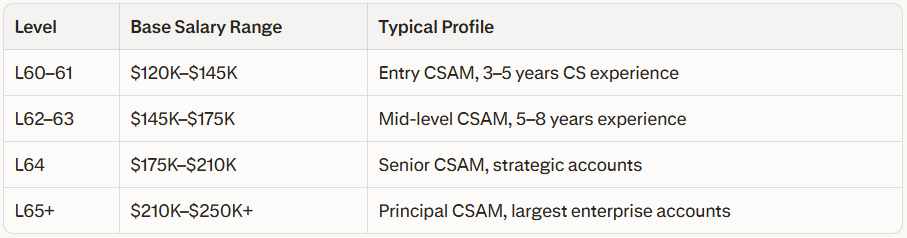
Base Salary Ranges by Experience Level
Microsoft structures CSAM compensation based on internal level designations. Your starting level depends on previous experience, with most CSAMs entering between levels 60–63.
Location significantly impacts base salary. Expect higher compensation in premium markets like San Francisco, Seattle, and New York compared to Dallas or Houston.
Bonus Structure
Microsoft CSAMs receive performance-based annual bonuses paid each September:
Level 60–61: 10–15% of base salary
Level 62–63: 15–20% of base salary
Level 64+: 20–30% of base salary
Bonuses are tied to customer satisfaction scores, product adoption rates, renewal rates, and strategic account growth. High performers can significantly exceed target percentages, with some senior CSAMs reporting bonuses up to $98,000.
Stock Compensation (RSUs)
Restricted Stock Units form a significant portion of total compensation, especially at higher levels:
On-Hire Stock Awards: Typically vest over 4 years (25% annually)
Annual Stock Awards: Vest over 5 years (20% annually), with quarterly vesting
Special Stock Awards (SSAs): Additional grants for exceptional performers
RSU Values by Level:
Level 60–61: $3,000–$17,000 annually
Level 62–63: $15,000–$31,000 annually
Level 64: $29,000–$61,000 annually
Level 65+: $60,000+ annually
Microsoft RSUs vest quarterly in February, May, August, and November after the first-year cliff.
Additional Benefits
Health and Wellness: Comprehensive medical, dental, and vision coverage
Retirement: 401(k) with company matching
Education: Free access to Microsoft certifications and learning resources
Work-Life Balance: Flexible scheduling and robust remote work options
Deferred Compensation: Available for Level 67+ employees
ESPP: Purchase Microsoft stock at a discount
Signing Bonuses: $25,000–$50,000 for new hires (varies by level and negotiation)
Microsoft CSAM vs. Other Tech Giants
Microsoft typically pays 10–20% less than Google for comparable roles, but is consistently rated higher for work-life balance and supportive culture.
For a full benchmark of CS compensation across companies and levels, including negotiation strategies that have secured $30K+ increases, see the complete CSM compensation guide.
Negotiation Insights
Level Designation: Pushing for a higher level (e.g., from L62 to L63) significantly increases all compensation components. This is your highest leverage point.
Stock vs. Base: Microsoft may be more flexible with stock grants than base salary. If they won’t budge on base, negotiate for higher RSUs.
Location Impact: Up to 30% difference between high and low-cost markets. Remote roles typically follow where you reside.
Prior Experience: Highlighting customer success experience with quantified outcomes (NRR improvement, consumption growth, renewals) can justify higher starting levels.
Why Cybersecurity and Enterprise CS Roles Are Breaking the $100K Barrier
CS professionals in cybersecurity companies or managing Fortune 500 accounts frequently report salaries above $100K, even below the director level.
The market is evolving, and companies are willing to pay premium rates for CS pros who drive measurable business outcomes.
What makes the Microsoft CSAM role stand out: it combines high earning potential with a clear growth path, strategic influence, and less competition than traditional CS roles.
If you’ve worked in high-impact CS environments, you’re already ahead of the curve.
Tools and Technologies Used by Microsoft CSAMs
Core Platforms:
Microsoft Dynamics 365: CRM system for managing customer interactions, tracking engagement, and monitoring account health
Azure AI Studio: Platform for exploring and implementing AI solutions with customers, leveraging GPT-4, Phi-3, and other models
Microsoft Teams: Essential for collaboration with internal teams and customers
Power BI: Business analytics tool for creating dashboards and reports for data-driven decision-making
Technical & Project Management:
Azure DevOps: Project management and tracking customer implementation progress
Azure Monitor and Log Analytics: Track and analyze customer usage patterns and system health
Services Hub: Unified platform for managing customer engagements, health assessments, and program delivery
Learning & Development:
Microsoft Learn: Platform for staying updated on the latest Microsoft technologies and earning certifications
Health Scoring and RYG Reviews
A key part of the CSAM role is offering proactive health checks and strategic training.
These health checks allow CSAMs to assess customer health and categorize status using a Red, Yellow, Green (RYG) health scoring system.
This RYG review helps CSAMs identify where customers need more support from Microsoft and prioritize interventions before small issues become renewal risks. The best CSAMs don’t just track RYG.
They define objective, signal-based thresholds for each color and run a 15-minute weekly review that keeps the entire portfolio visible without overwhelming the team.
If your current health scoring is based on gut feel rather than measurable signals, that’s one of the first things to fix, both for interview prep and day-one performance in the role.
The Unique Advantage of Microsoft CSAMs
The CSAM role uniquely blends customer advocacy with revenue responsibility.
Unlike traditional CSMs who focus purely on customer outcomes, Microsoft CSAMs also lead strategic selling conversations, in close collaboration with Account Executives and Technology Strategists.
The CSAM becomes the trusted advisor who identifies expansion opportunities, builds business cases for additional workloads, and drives consumption growth, all while maintaining deep customer relationships.
This is also why the transition from CSM to a role like CSAM, or even into product management, is increasingly common for CS professionals who want to grow their strategic scope and compensation.
Unique Challenges Faced by Microsoft CSAMs
The Services Model Challenge
Unlike CSMs in SaaS companies, where customer success is included in the subscription, Microsoft CSAMs often sell their services as add-ons.
They must continuously prove substantial value to justify the cost.
As Alvaro Ullate explained to me, “The client has to pay for their services, so they have to prove a lot of value. Sometimes this is hard because Microsoft’s interests are different from the client’s. You end up having to fight against both Microsoft and the client.”
Internal Selling & Coordination
Microsoft CSAMs face internal political challenges when coordinating efforts.
Since CSAM services have clear costs, they must sell them internally and get Account Executives to include them in client deals.
“This takes up a lot of time. The CSAMs have to sell their services inside Microsoft and work with Account Managers to make sure they’re part of the client contract.”
Time Allocation Trade-offs
All this internal negotiation and alignment can reduce the time CSAMs have to deeply understand and help each customer.
Understanding these challenges is essential. While the role is highly strategic, you must navigate complex internal and external relationships while balancing multiple priorities simultaneously.
Industry Trends Affecting Microsoft CSAMs in 2026
AI and Automation: The rise of AI is fundamentally changing how CSAMs work, with more emphasis on strategic advisory roles as routine tasks become automated. CSAMs increasingly guide customers on AI adoption strategies, particularly Copilot deployment and agentic workflows.
Cloud Migration: As more businesses move to the cloud, CSAMs need deep expertise in migration strategies, architecture best practices, and multi-cloud environments.
Cybersecurity Focus: With escalating cyber threats, CSAMs are expected to have a strong understanding of security features across Microsoft’s platform, especially Zero Trust architectures.
Remote Work Solutions: The shift to hybrid work models has increased demand for expertise in collaboration tools (Teams, SharePoint) and digital workplace transformation.
Data Analytics and Insights: CSAMs are increasingly expected to leverage data analytics to provide predictive insights and actionable recommendations to customers.
Sustainability Initiatives: Growing emphasis on environmental sustainability requires CSAMs to understand and promote Microsoft’s green tech solutions and help customers achieve ESG goals.
Outcome-Based Selling: The focus has shifted from product features to measurable business outcomes, requiring CSAMs to align closely with customer business goals and demonstrate ROI. This mirrors the broader shift happening across CS, from CS being viewed as a cost center to CS being viewed as a revenue protection function.
Case Studies: CSAM Success Stories
Global Retailer’s Cloud Migration
A CSAM worked closely with a major retail chain to migrate legacy systems to Azure by coordinating Microsoft FastTrack engineers, security specialists, and solution architects.
Results:
Improved scalability during peak shopping seasons
30% reduction in IT infrastructure costs
Zero downtime during migration
Healthcare Provider’s Data Security Overhaul
When a healthcare organization faced increasing cybersecurity threats, its CSAM brought in Microsoft’s security experts to implement a comprehensive solution using Microsoft 365 Defender and Azure Security Center.
Results:
50% decrease in security incidents within 6 months
Achieved HIPAA compliance with strict data protection regulations
Implemented Zero Trust architecture protecting 10,000+ endpoints
Manufacturing Company’s AI Integration
A CSAM helped a manufacturing client leverage Azure AI to optimize their supply chain through predictive maintenance and demand forecasting models.
Results:
25% reduction in equipment downtime
40% improvement in inventory management efficiency
$2.3M annual cost savings
Financial Services Firm’s Remote Work Transition
During the global pandemic, a CSAM assisted a large financial services company in rapidly deploying Microsoft Teams and related security measures.
Results:
Seamless transition of 15,000 employees to remote work in 3 weeks
Maintained operations without interruption
18% increase in employee satisfaction and productivity scores
Application and Interview Tips
Resume Tips for Microsoft CSAM Applications
Highlight Microsoft Technology Experience: Emphasize your experience with Azure, Microsoft 365, and Security platforms. Even tangential experience counts.
Quantify Revenue Impact: Use specific metrics:
“Drove 32% NRR improvement across 8 enterprise accounts.”
“Increased Azure consumption by $1.2M ARR through strategic adoption programs”
Show Strategic Account Management: Demonstrate experience managing complex, high-value accounts with multiple stakeholders.
Include Certifications: List relevant Microsoft certifications (Azure Fundamentals AZ-900, M365, Security). If you don’t have them, get AZ-900 before applying.
Emphasize Orchestration: Highlight examples of coordinating cross-functional teams to deliver outcomes.
Before we get into how to land it: roles like this at Microsoft get hundreds of applicants, and an ATS screens every resume before a recruiter sees one. If yours doesn’t clear that filter, the rest of this guide never gets a chance to matter. Paste your resume here and see exactly what Microsoft’s system flags: free check →
Common Interview Questions with Sample Answers
“How would you handle a customer who is resistant to adopting new Microsoft technologies?”
“I would start by understanding their specific concerns and business needs through discovery questions. Often, resistance comes from change management challenges, not the technology itself. I’d develop a tailored adoption plan that addresses their pain points and demonstrates clear ROI with quick wins. I’d leverage case studies from similar customers who’ve successfully implemented the technology and offer a pilot program to reduce risk. Finally, I’d ensure we have executive sponsorship on their side and provide comprehensive change management support throughout the journey.”
“Describe a time when you had to manage multiple high-priority customer accounts simultaneously.”
“In my previous role, I managed three enterprise accounts during a major product launch, combined $8M ARR. I created detailed project plans for each account, prioritizing tasks based on urgency and revenue impact. I leveraged our internal teams effectively, delegating specific technical responsibilities to solution engineers while maintaining overall accountability and customer relationships. I implemented a weekly rhythm of business reviews internally and bi-weekly check-ins with each customer. As a result, all three accounts successfully adopted the new product within the target timeframe, and we achieved 125% NRR across the portfolio that year.”
“How do you measure success in a customer success role?”
“Success in customer success is multidimensional. The primary metrics I focus on are customer health scores, Net Revenue Retention, product adoption rates, and consumption growth. But I also look at leading indicators like engagement frequency, feature utilization depth, executive relationships, and time-to-value for new deployments. Ultimately, success means customers achieve their business outcomes, whether that’s cost savings, revenue growth, or operational efficiency, and they expand their investment with us as a result. If I’m doing my job well, customers see us as a strategic partner, not just a vendor.”
Microsoft’s Interview Process Breakdown
Initial phone screening with a recruiter (30 minutes)
Technical assessment focusing on Microsoft products and CS strategies (60 minutes)
Panel interview with team members and potential colleagues (2–4 hours)
Final interview with a senior leader or hiring manager
Reference checks and offer stage
Tips from Successful Candidates
Demonstrate Passion
Show genuine enthusiasm for technology and customer success. Microsoft values cultural fit highly.
Prepare Specific Examples
Showcase your ability to drive business outcomes with quantified results. Use the STAR method consistently.
Understand Microsoft’s Strategy
Show your understanding of Microsoft’s cloud-first, AI-first strategy and how CSAMs fit into that vision.
Stay Current
Be prepared to discuss how you stay updated on industry trends, new Microsoft technologies, and emerging customer needs. Mentioning resources like my CS Cafe newsletter signals you’re actively investing in your CS knowledge.
Know Your “Three Circles of Impact”:
Key accomplishments that contribute to team, business, or customer results
Your contributions to the success of others
Results you’ve built on the work, ideas, or efforts of others
Career Path and Progression for Microsoft CSAMs
Vertical Progression: CSAMs can advance to senior CSAM roles (Level 65+), taking on larger or more strategic accounts with higher revenue responsibility.
Specialization Tracks: Some CSAMs specialize in specific industries (healthcare, financial services, retail) or Microsoft technologies (AI/Copilot, Security, Azure infrastructure), becoming subject matter experts.
Leadership Roles: Experienced CSAMs move into management positions, leading teams of CSAMs or transitioning to CS leadership roles.
Cross-functional Opportunities: The broad exposure CSAMs get opens doors to sales, product management, technical consulting, or solution architecture roles within Microsoft. The CSM to PM transition is one of the most common paths for CSAMs who want to move toward product.
Global Roles: Microsoft’s global presence offers opportunities for CSAMs to take on international responsibilities or relocate to different markets.
Customer Success Leadership: CSAMs can progress to Director, VP, or Chief Customer Officer roles, shaping overall strategy for customer engagement across regions or industries.
Breaking Into Microsoft CSAM From Another Role
From Sales or Account Management: Your revenue focus and stakeholder management skills are highly valued. Focus on consumption growth stories, strategic account expansion, and NRR impact.
From Technical Roles: Your product knowledge is a significant advantage. Emphasize how you’ve translated technical capabilities into business outcomes.
My developer to customer success transition guide shows exactly how to position your technical background.
From Product Management: Showcase examples of driving adoption, managing stakeholder expectations, and delivering customer outcomes.
From Consulting or Professional Services: Your project delivery and stakeholder management skills transfer directly.
Emphasize customer relationship building, change management, and business outcome achievement.
From Other Industries: Focus on transferable skills: executive relationship building, strategic planning, and cross-functional coordination.
See the complete guide on transitioning into customer success from a non-CS background for the positioning framework that has worked.
Future of the CSAM Role at Microsoft
AI Integration: With the advancement of generative AI and agentic workflows, CSAMs will leverage AI tools to provide predictive insights and automate routine tasks, allowing more focus on strategic advisory and complex problem-solving.
Increased Specialization: As Microsoft’s product ecosystem grows more complex, CSAMs will likely specialize in specific industries or technology stacks (AI/Copilot, Security, Data & AI, Infrastructure).
Emphasis on Business Outcomes: The focus will shift even more toward demonstrable ROI, requiring CSAMs to develop stronger business acumen and financial analysis skills.
Ethical AI Guidance: As AI becomes more prevalent in enterprise operations, CSAMs will guide customers on ethical AI implementation, governance frameworks, and responsible AI practices.
Continuous Learning Culture: The rapid pace of technological change requires CSAMs to stay ahead of emerging trends like quantum computing, agentic AI, and edge computing.
Want to Land a Microsoft CSAM Role?
If you're actively targeting this role, I work with CS leaders 1:1 to fix positioning, rebuild the resume for Microsoft's hiring framework, and prepare for the interview system. All async, no calls required.
→ See how it works: 1-1 Coaching
If this guide helped you understand the Microsoft CSAM role, join 4,300+ CS professionals who get proven frameworks, ready-to-use playbooks, and career-accelerating insights every week.
— Hakan, Founder of The CS Café