
Best NPS Tools for Customer Success Teams (2026 Guide)
Turn Feedback into Revenue with the Right Net Promoter Score Solution

Last Updated: March 2, 2026
Looking for the best NPS tool for your team?
Most “best NPS software” lists are useless because they optimize for features, not outcomes. Here’s what actually matters:
Can you close the loop fast enough to prevent churn?
Can you route feedback to the right owner without manual work?
Can you prove NPS impact in retention, expansion, or referrals?
This guide ranks the top Net Promoter Score platforms by price, automation, integrations, and implementation difficulty, plus the decision rules CS leaders use to avoid buying the wrong tool.
If you want NPS to protect revenue, pair this with the 30-Day Anti-Churn operating system so every detractor response feeds directly into your at-risk account workflow.
One Important 2026 Alert: Delighted Is Sunsetting
If Delighted is on your shortlist, you need to know this now:
Delighted is shutting down on June 30, 2026. Customers cannot renew annual subscriptions starting July 1, 2025. (Source: Delighted sunset notice)
That doesn’t mean “never buy it”, but it does mean you’re buying a tool you will have to replace. Plan migration timelines accordingly before evaluating it.
What Is NPS?
NPS stands for Net Promoter Score, a method for measuring customer loyalty and predicting growth with a single question:
“How likely are you to recommend our product or service to others?”
Customers answer on a 0–10 scale:
Promoters (9–10): Loyal advocates who refer others
Passives (7–8): Neutral users vulnerable to competitors
Detractors (0–6): Unhappy customers who churn — or worse
NPS = % Promoters − % Detractors
NPS is only useful when it feeds your retention machine.
If you’re building the full CS scorecard, use the Ultimate Guide: Success Metrics for CS Leaders and the Net Revenue Retention (NRR) Calculator alongside it.
Why NPS Matters More in 2026
In 2026, buyer journeys are nonlinear and shaped by word of mouth, community, and social proof. NPS is no longer “just a survey.”
Used correctly, it becomes three things at once:
Early-warning radar — risk signals before tickets spike
A routing system — who owns what next, automatically
Exec language — customer sentiment tied to revenue, not gut feel
If you need to set goals and align teams before sending a single survey, start from a real Customer Success Plan Template, not random survey sends.
How to Choose the Right NPS Tool (The Only Framework You Need)
Step 1: Pick the one job your NPS program must do
Choose a single primary objective:
Retention defense: detractor response time + escalation routing
Expansion signal: promoter activation + intent capture
Brand proof: reviews, testimonials, case-study sourcing
Trying to do all three on day one is how teams end up doing none. Once you’ve mastered one motion, layer in the next.
A good churn post-mortem system will tell you which of these three jobs matters most at your current churn rate.
Step 2: Match your tool to your operating maturity
If you don’t have a workflow owner, buy simple
If you do have a workflow owner, buy automation
If you have a CS ops function, buy integrations
Step 3: Audit integrations before you fall in love
If it doesn’t connect to your CRM and comms layer, expect manual work and broken loops. The integration test should happen before the contract is signed, not after.
Step 4: Decide your “close the loop” SLA
If you can’t respond to detractors within 48 hours, your NPS score becomes a monthly guilt report. Set your SLA before you pick a tool; the SLA determines the automation you need.
Use the exec-facing meeting structure in Strategic QBR Frameworks to present NPS trends in a format that drives decisions.
2026 NPS Tool Comparison by Tier
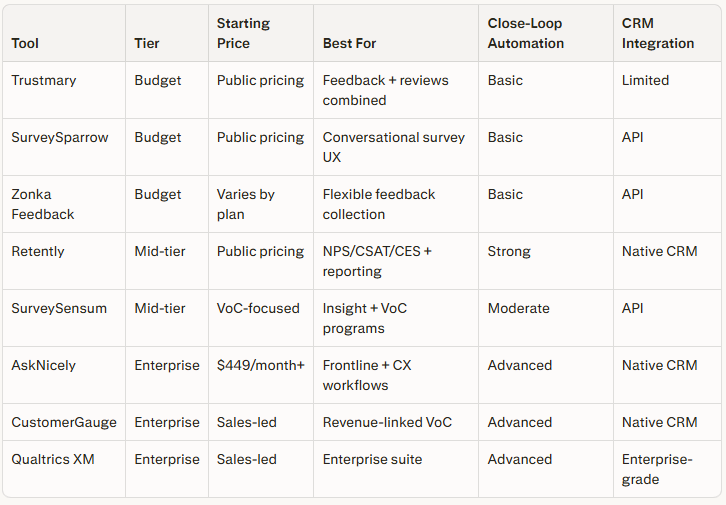
Note: Delighted has been excluded. It is sunsetting on June 30, 2026.
Detailed Tool Reviews
Trustmary: Budget Tier, Feedback + Reviews Combined
Best for: Small CS teams that want to convert NPS promoters into reviews and testimonials in one step
Pricing: Public. See trustmary.com
Trustmary is the one budget-tier tool with a built-in promoter activation workflow. Most NPS tools stop at collecting the score.
Trustmary goes one step further and prompts Promoters to leave a review or provide a testimonial immediately after responding, which makes it unusually effective for CS teams who are trying to convert NPS into renewal and expansion signals.
Use it if: You’re a small team that wants feedback collection and social proof in a single motion.
Skip it if: You need advanced CRM automation or multi-team routing.
SurveySparrow: Budget Tier, Conversational UX
Best for: Teams where survey response rates are low, and engagement is the first problem to solve
Pricing: Public. See surveysparrow.com
SurveySparrow’s differentiator is format: conversational, chat-style surveys consistently outperform traditional forms on mobile. If your customer base skews toward SMB accounts with limited engagement time, the format lift alone can justify the choice.
Use it if: Response rate is your primary problem.
Skip it if: You need robust automation rules and CRM integration out of the box.
Zonka Feedback: Budget Tier, Flexible Collection
Best for: Teams collecting NPS across multiple channels (in-app, email, kiosk, SMS)
Pricing: Varies by plan, see zonkafeedback.com
Zonka Feedback is one of the most channel-flexible tools in the budget tier. If your NPS program needs to run across different customer touchpoints simultaneously (onboarding, mid-cycle, and renewal), Zonka handles that without forcing you into an enterprise contract.
Use it if: Multi-channel feedback collection is a requirement.
Skip it if: You want deep workflow automation from day one.
Retently: Mid-Tier, NPS + CSAT + CES in One
Best for: CS teams that want to track multiple feedback types (NPS, CSAT, CES) with clean automation and reporting
Pricing: Public, see retently.com
Retently is the cleanest mid-tier option for CS teams that have moved past “just collecting NPS” and need to track the full voice-of-customer stack. It handles NPS, CSAT, and CES in a single platform with native automation rules and reporting built for CS workflows, not marketing teams.
Use it if: You’ve already run NPS for one cycle and now need structure and automation.
Skip it if: You need deep enterprise-grade routing across multiple business units.
SurveySensum: Mid-Tier, VoC Intelligence Focus
Best for: CS teams that need to extract insights and themes from open-text feedback at scale
Pricing: See surveysensum.com (VoC-focused pricing)
SurveySensum’s positioning is insight-first, not just survey-first. Its AI-driven text analytics pull themes and root causes from open responses automatically — which matters when you have hundreds of monthly responses and no analyst to read them manually.
Use it if: Volume of open-text responses is making manual analysis impossible.
Skip it if: You want a simple set-and-forget NPS sender with minimal overhead.
AskNicely: Enterprise, Frontline + CX Workflows
Best for: CS teams managing high-volume customer interactions across frontline service touchpoints
Pricing: Starting at $449/month (publicly cited)
AskNicely is purpose-built for service-heavy businesses where NPS needs to be collected and acted on at the frontline level, not just quarterly. It’s a strong fit for CS leaders who need to connect individual customer feedback to specific CSM performance and coaching loops.
Use it if: You manage a large frontline CS team and want NPS connected to team coaching.
Skip it if: You’re a small team, the pricing and feature set are built for scale.
CustomerGauge: Enterprise, Revenue-Linked VoC
Best for: CS leaders who need to tie NPS directly to ARR, churn risk, and account expansion metrics
Pricing: Sales-led. Contact customerauge.com
CustomerGauge is the most revenue-centric NPS platform on this list. Its “Account Experience” framework connects survey responses directly to account-level revenue data, making it the natural choice for CS leaders who present NPS in boardroom-level QBRs tied to ARR at risk.
If you run QBRs where CS is presenting as a P&L function, CustomerGauge gives you the revenue-tied NPS reporting that most tools can’t produce natively.
Use it if: Your CS team is accountable for NRR and you present to the CFO or board.
Skip it if: You’re earlier stage and NPS is not yet connected to revenue reporting.
Qualtrics XM: Enterprise Suite
Best for: Large enterprises that need NPS as one component of a broader Voice of Customer and CX measurement program
Pricing: Sales-led enterprise pricing
Qualtrics is not a CS tool; it’s an enterprise research platform that happens to include NPS. The upside: unmatched depth and flexibility. The downside: complexity and cost that make it overkill for teams that just need NPS with good automation.
Use it if: You’re in a large enterprise with a dedicated CX/research function and NPS is part of a broader measurement strategy.
Skip it if: You’re a CS-focused team that just needs clean NPS with fast loop-closing.
Implementation Difficulty: The Reality
Implementation difficulty is mostly about your company, not the software.
If you have clean customer data + clear ownership, most tools feel easy
If you don’t, every tool feels “buggy” — because your process is the problem
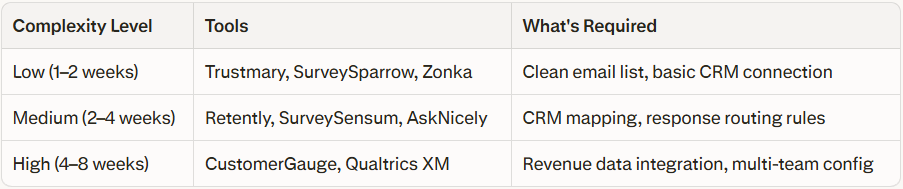
Before implementation, centralize your retention mechanics and reporting using the Net Revenue Retention Guide and the CS Calculators hub, so you can quantify NPS impact when leadership asks.
2026 Benchmarks (Use Carefully)
Benchmarks are directionally useful, not a strategy. If leadership is pushing you for “what’s good,” treat benchmarks as a starting point, then anchor on your segment, ACV, and product maturity.
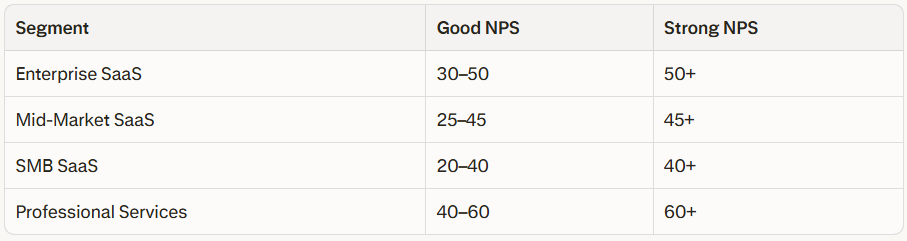
The most important benchmark isn’t vs. industry. It’s your own score quarter-over-quarter, paired with what you did to move it.
NPS Best Practices That Actually Move Revenue
1. Pilot like an operator
2 weeks
100–300 users
One segment only
Don’t pilot NPS across your entire customer base first. One segment, clean data, fast learning loop.
2. Close the loop fast
Reach out to every detractor within 48 hours
Tag root cause (product, support, onboarding, value gap)
Assign an owner
Track resolution to completion
The 48-hour window is not arbitrary.
Research consistently shows that the detractor recovery rate drops sharply beyond it. The RYG health scoring system is the right place to integrate detractor flags so the alert reaches the right CSM automatically.
3. Turn promoters into proof
If you aren’t converting Promoters into reviews, referrals, and expansion conversations, you’re leaving money on the table.
A simple way to operationalize this: treat promoter outreach as a repeatable motion inside your renewal and upsell/expansion playbook, not an ad hoc “ask” that happens when someone remembers.
4. Make the program visible to leadership
Weekly: Top themes + top risk accounts
Monthly: Trends + action taken on detractors
Quarterly: NPS + retention story inside QBR, tied to ARR
Use the Executive Engagement Tactics guide to frame NPS data in language your exec team responds to. Revenue impact, not survey scores.
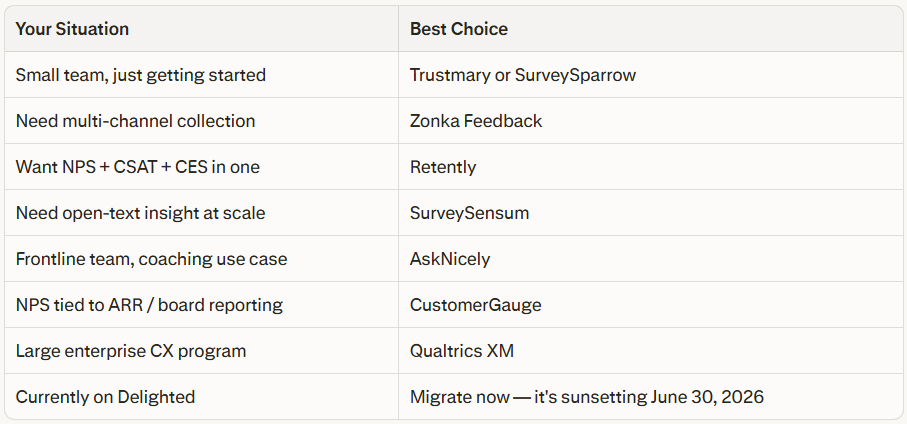
Quick-Decision Table: Which NPS Tool for Which Team
Want Hands-On Help?
Need support choosing or implementing your NPS tool?
1:1 consulting: Customer Success Café Consulting
Vendor partnerships: CS Café Vendor Partnerships
Join 4,300+ CS professionals who subscribe to The Customer Success Café for proven frameworks, expert guides, and career tools.
Hakan, Founder | The Weekly Customer Success Café Newsletter | TheCScafe.com
I would definitely recommend Formester to this list. I would love to set you up if you want to give it a try.