

Best Customer Success Platforms in 2026: Real Prices, Picked by Stage
Last Updated: May 9, 2026
Pricing reflects public starting points as of May 3, 2026. Vendors change packaging often, so confirm during evaluation.
The platform you pick matters less than whether your team adopts it by day 90. Underused platforms deliver close to zero ROI regardless of brand.
This guide ranks 8 platforms by three things most listicles skip: stage fit, Year-1 total cost of ownership, and the day-90 adoption risk that determines whether your investment pays back.
Pick by these three first. Feature parity comes later.
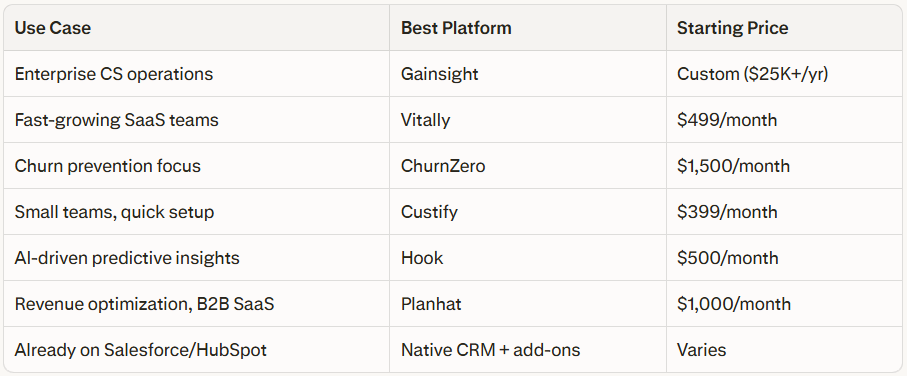
Pick the Right Platform in 60 Seconds
Choose based on your reality, not brand hype:
You run on Salesforce, have 1,000+ customers, and CS ops is mature: Start with Gainsight.
Mid-market SaaS (100–1,000 customers) and you need speed + automation: Start with Vitally. For the full growing-team shortlist, see the growing SaaS guide.
Retention is the whole job (renewals, churn risk, save plays): Start with ChurnZero.
NRR and expansion visibility are the priority: Start with Planhat.
Small team, want core CS fast: Start with Custify (or Hook if you’re data-heavy).
How This Guide Works
This is a stage-based guide, not a random “top 10.”
How platforms are grouped: by who they fit best (enterprise, mid-market, small teams, AI-first).
How I evaluate: integration depth, health-scoring flexibility, automation, exec reporting, time-to-value, and day-90 adoption risk.
Editorial promise: vendors can fund deeper testing and evaluation. They cannot buy rankings, soft treatment, or conclusions.
What Good Customer Success Software Must Do in 2026
Before comparing brands, get clear on non-negotiables. The platform that wins your evaluation should do all six of these:
1. Scalability
Supports your current base and the next 2–3 years of growth without a full re-implementation.
2. Integration strength
Connects cleanly to your CRM, product analytics tool, billing system, and support platform. If it doesn’t talk to your stack on day one, it won’t get used.
3. Signals and analytics
Turns raw data into health scores, risk flags, and expansion visibility. Most teams implement this as an RYG health scoring system (Red, Yellow, Green) with objective, measurable thresholds for each color.
If you still have to decide who’s at risk manually, the platform isn’t working.
4. Automation
Removes repetitive CSM work and enforces consistent playbooks across the team. Automation is what lets you scale coverage without scaling headcount.
5. ROI visibility
Lets you show leadership exactly what revenue you protected and what churn you prevented. This is what gets CS a seat at the boardroom table.
6. Data ownership
Clear source of truth for each signal (CRM, product, billing, support). If ownership is fuzzy, health scores become politics.
Most CS platform failures don’t come from picking the “wrong” vendor. They come from buying a tool that’s too complex for the team, underpowered for the data volume, or impossible to integrate with the existing stack.
The 50-Point CS Platform Scorecard
Score each platform you’re evaluating across five dimensions. 10 points per dimension. Total out of 50.
Anything under 35 is a no. Anything 35-42 needs a real proof of concept before signing. Above 42, run the procurement.
1. Stage Fit (10 points)
Does the platform match your customer count, CS team size, and CS Ops maturity?
10: Built specifically for your segment. Reference customers at your size are operating it well.
7: Adjacent segment. Will work with effort. Either over-featured or under-featured for your stage.
4: Wrong segment. You will outgrow it in 12 months or never grow into it.
0: Wrong segment and wrong direction of travel.
2. Integration Depth (10 points)
Native pre-built connectors to your CRM, billing, product analytics, and support tools.
10: All four native, working on day one.
7: Three native, one needs API configuration.
4: Two or fewer native, custom development needed.
0: Custom build for your core CRM. Walk away.
3. Day-90 Adoption Risk (10 points)
What’s the realistic chance your CSMs are using it daily by month three?
10: Implementation under 4 weeks. Interface CSMs want to use. Reference customers report >80% daily usage by day 90.
7: 6-8 week implementation. Some CSM resistance expected. Strong admin tools.
4: 8-12 week implementation. Heavy admin overhead. Adoption depends on dedicated CS Ops resource.
0: No clear path to daily CSM use. The platform becomes a dashboard nobody opens.
4. Year-1 Total Cost of Ownership (10 points)
Subscription plus implementation plus training plus integration work plus migration.
10: Year-1 TCO under 1.5x annual subscription.
7: Year-1 TCO 1.5-2x annual subscription.
4: Year-1 TCO 2-3x annual subscription.
0: Year-1 TCO over 3x annual subscription. Budget will not survive.
5. Exec Reporting (10 points)
ARR-at-risk, NRR by segment, save-play results, all exportable for the boardroom.
10: Out-of-the-box exec dashboards. CFO and board view ARR-by-color in one click.
7: Exec views available with light customization.
4: Exec reporting requires CS Ops to rebuild manually each quarter.
0: No exec reporting layer. You’ll keep building decks in Excel forever.
Run this scorecard with your top 3 shortlisted platforms before booking demos. The scorecard is the input. The demos test what scored highest, in your environment, with your data.
Customer Success Platform Comparison 2026
Best Customer Success Software by Company Size
Enterprise (1,000+ customers)
Gainsight: Full-featured, custom pricing, strong Salesforce-native footprint
Totango + Catalyst: Advanced AI, strong for high-growth companies
ChurnZero: Specialized churn prevention, starts at $1,500/month
Mid-Market (100–1,000 customers)
Vitally: Fast setup (2–3 weeks), modern design, starts at $499/month
Planhat: Revenue optimization focus, starts at $1,000/month
Small Teams (under 100 customers)
Custify: Easy to deploy, essential CS metrics, starts at $399/month
Hook: AI-driven churn prediction, starts at $500/month
The 5-Question Decision Tree
Five yes/no questions. Answer in order. Stop when you hit a routing.
Q1. Is your entire revenue org on Salesforce, with 1,000+ customers and a dedicated CS Ops function?
Yes → Gainsight. The Salesforce-native depth is non-negotiable at this scale.
No → Continue to Q2.
Q2. Is your single biggest problem churn detection and save-play execution, more than expansion or onboarding?
Yes → ChurnZero. Built for retention as the primary job.
No → Continue to Q3.
Q3. Is NRR the metric your CS team is measured on, with expansion as a primary mandate?
Yes → Planhat. Revenue visibility is its core architecture.
No → Continue to Q4.
Q4. Are you mid-market (100-1,000 customers), scaling without adding headcount, and need to be live in weeks?
Yes → Vitally. 2-3 week implementation, modern automation, designed for scaled CS.
No → Continue to Q5.
Q5. Is your team under 100 customers, with limited CS Ops resource?
Yes, and we have strong analytics culture → Hook. AI-first predictive signals with minimal setup.
Yes, and we want core CS fast → Custify. The no-drama choice.
No to both → You’re either pre-platform (stay in CRM) or you have a Q1-Q4 answer you skipped. Re-run the tree.
This tree gives you a starting point, not a final answer. Run the 50-point scorecard against your routed platform plus one alternative before you sign anything.
Top Customer Success Platforms: Detailed Reviews
1. Gainsight: Enterprise-Grade CS Management
Best for: Large enterprises with complex CS operations
Pricing: Custom (typically $25,000+ annually)
Free trial: Demo available
Gainsight is the market reference for enterprise CS.
Published case studies often report meaningful churn improvement after full deployment. Your outcome will depend on adoption, data quality, and whether you operationalize save plays, not just dashboards.
Key capabilities:
360° customer health monitoring with customizable scoring
Predictive churn analytics
Enterprise-grade security and compliance
Native Salesforce integration, widely considered best-in-class.
Gainsight is usually the default choice when Salesforce is non-negotiable and you need CS-specific workflows.
Honest limitation: Gainsight is powerful and complex. Implementation takes 8–12 weeks and requires dedicated resources. It’s the right tool for large, mature CS organizations. Not for teams that need to be live in 2 weeks.
2. Vitally: The Modern Platform for Fast-Growing Teams
Best for: Growing SaaS companies (100–1,000 customers)
Pricing: Starting at $499/month
Free trial: 14 days
Vitally is the platform I point most mid-market teams to first. It combines powerful automation with an interface teams actually want to use, and it goes live in 2–3 weeks, not 2–3 months.
It’s particularly effective for teams looking to scale from 100 to 1,000 customers without adding headcount, using pooled or scaled CS models.
Standout features:
AI-powered customer health scoring
Automated playbooks and workflows
Real-time analytics dashboard
Average 2–3 week implementation time
Vitally vs. Gainsight (when to choose which):
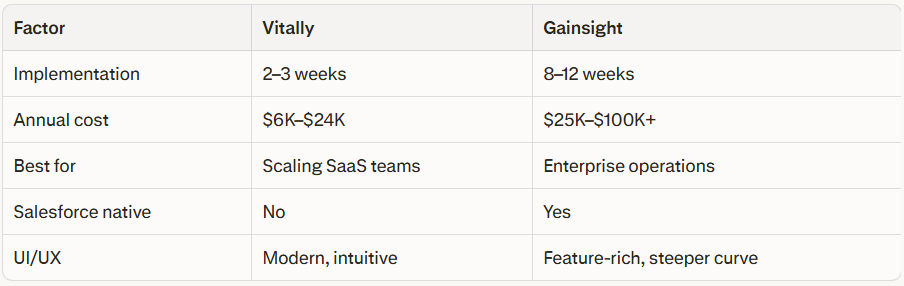
Choose Vitally if:
You need to be live in weeks, not quarters
Your team is scaling coverage without adding headcount
You want strong workflows without heavy admin overhead
Choose Gainsight if:
You run complex enterprise motions and need deep customization
Salesforce is the system of record for the whole revenue org
You have CS Ops resources to own the platform long-term
If you are a growing or scaling team weighing this whole category, the growing SaaS software guide compares Vitally against the other growing-team tools in depth.
3. ChurnZero: Churn Prevention Specialist
Best for: Retention-focused CS teams
Pricing: Starting at $1,500/month
ChurnZero does one thing exceptionally well: preventing churn before it happens. Its proprietary ChurnScore algorithm is the most configurable health score engine outside of Gainsight.
And when an account does churn, it gives you the data trail you need to run a proper post-mortem and feed the learning back into your ICP.
Platform highlights:
Real-time customer health monitoring
Customizable ChurnScore algorithm
In-app engagement tools
Native revenue tracking
ChurnZero vs. Gainsight:
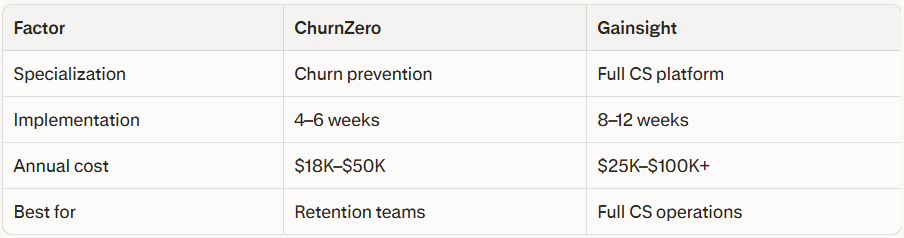
Choose ChurnZero if:
Your main problem is churn detection + save plays
You want a retention-first engine that’s easier to operationalize
Choose Gainsight if:
You need broader enterprise workflows across many teams
You need deep governance, customization, and scale controls
4. Planhat: Revenue Optimization for B2B SaaS
Best for: B2B SaaS companies focused on expansion revenue
Pricing: From $1,000/month
Planhat is the platform CS teams choose when NRR is the primary metric. It’s built around revenue visibility, with a flexible data architecture and custom reporting engine that most platforms can’t match.
If your CS team is accountable for Net Revenue Retention, not just renewals, Planhat gives you the clearest view of where expansion is and where it’s at risk.
Key differentiators:
Revenue optimization and expansion tracking
Custom reporting engine
Advanced workflow automation
API-first architecture (easier for technical teams)
Pairs well with a dedicated NPS survey tool to combine sentiment data with behavioral signals in one health score view.
5. Totango + Catalyst: The Merged CS Powerhouse
Best for: High-growth SaaS companies
Pricing: Custom
Following their merger, this combined platform offers no-code workflow automation, AI-driven customer insights, and rapid time-to-value implementation.
Strong choice for teams that want Gainsight-level depth without Gainsight-level complexity.
6. Hook: AI-First Predictive Intelligence
Best for: Data-driven CS teams, smaller organizations with strong analytics culture
Pricing: Starting at $500/month
Hook is the sharpest tool for predictive analytics in this list. It spots churn risk and expansion signals before most platforms would flag anything, and it does it with minimal configuration.
Hook vs. Gainsight on AI:
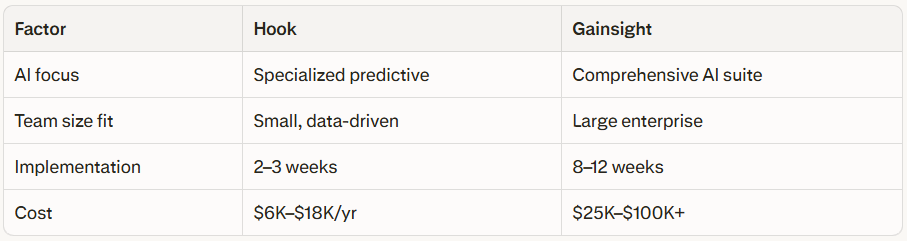
Choose Hook if:
You want predictive signals fast with minimal setup
You have strong data discipline and want early-warning precision
Choose Gainsight if:
You need AI inside a full enterprise CS operating system
You care as much about workflows and reporting as prediction
7. Custify: The Practical Choice for Small Teams
Best for: Small to mid-size B2B companies
Pricing: From $399/month
Custify is the no-drama option for teams that need core CS functionality fast.
Quick setup, automated customer touchpoints, user-friendly interface, and essential health score metrics. It doesn’t win on depth. It wins on speed to value.
8. Zapscale: Emerging AI-First Player
Best for: Teams evaluating AI-native CS platforms
Focused on predictive analytics and portfolio intelligence for growing CS teams.
Gainsight vs. HubSpot vs. Salesforce: Which to Use If You’re Already in a CRM
This is the question I get most from CS leaders at companies that already have a CRM investment.
Here’s the quick decision framework:
Use Gainsight (native Salesforce add-on) if:
Your entire revenue org runs on Salesforce
You need CS-specific workflows that your CRM can’t support
You have the budget and implementation capacity
Use HubSpot CS Hub if:
Your company is mid-market and already runs marketing + sales on HubSpot
You want CS and CRM in one platform without a separate integration
Budget is a real constraint (HubSpot is significantly cheaper than Gainsight)
Stay in native CRM (Salesforce or HubSpot) if:
Your CS team is small (1–5 CSMs), and your accounts are manageable manually
You’re pre-product-market-fit, and CS is still informal
You’re not yet tracking health scores, playbooks, or portfolio ARR at risk
How to Choose the Right Customer Success Platform: 3-Step Framework
Step 1: Match to Your Stage
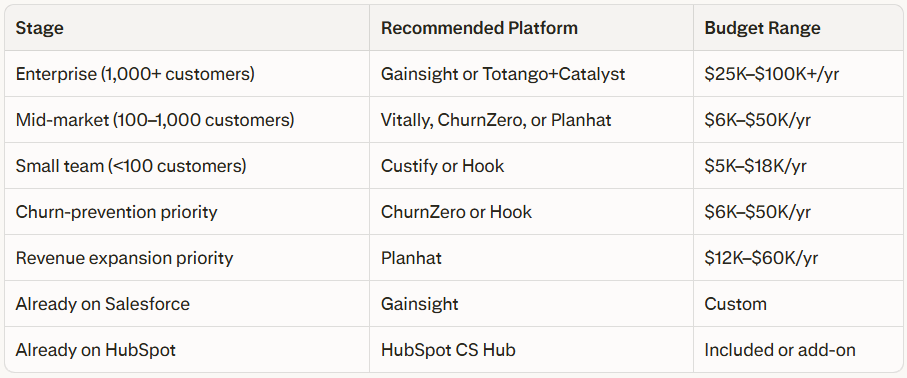
Step 2: Calculate True Cost of Ownership
Most CS leaders only look at the subscription price. The real cost includes:
Base subscription
Implementation fees ($5,000–$15,000 for most platforms)
Team training time (1–2 weeks minimum)
Additional user licenses
Integration work with CRM, billing, and product analytics
Data migration (1–4 weeks, often the longest phase)
A platform at $499/month with a $10,000 implementation fee has a year-1 cost of ~$16K — not $6K.
If you want the model pre-built, the CS Platform Buyer’s Kit ships with a 3-year TCO calculator, NRR-lift ROI at three scenarios, and a one-page exec summary that pulls live from the cost model. Built for the CFO meeting that follows.
Step 3: Validate Before You Sign
Before purchase, do all three:
Request a live demo with your own data, not a canned demo environment
Speak with a reference customer at your company size, not a Fortune 500 logo, if you’re mid-market
Run a real integration test, connect to your CRM, and confirm the data flows correctly before signing
Run the full procurement without the buyer’s remorse
The 3-step framework above is the operating system. The CS Platform Buyer’s Kit ships the working files.
Excel workbook with the scoring matrix, 40-question RFP bank, demo scorecard, reference check script, full TCO model with NRR-lift ROI, and a one-page exec summary the CFO actually reads.
14 platforms pre-loaded. 13-page PDF playbook with 10 chapters and 4 email templates. $79. Single procurement, yours forever.
→ Get the CS Platform Buyer’s Kit
Customer Success Platform ROI: What to Expect
Based on implementation data and published case studies:
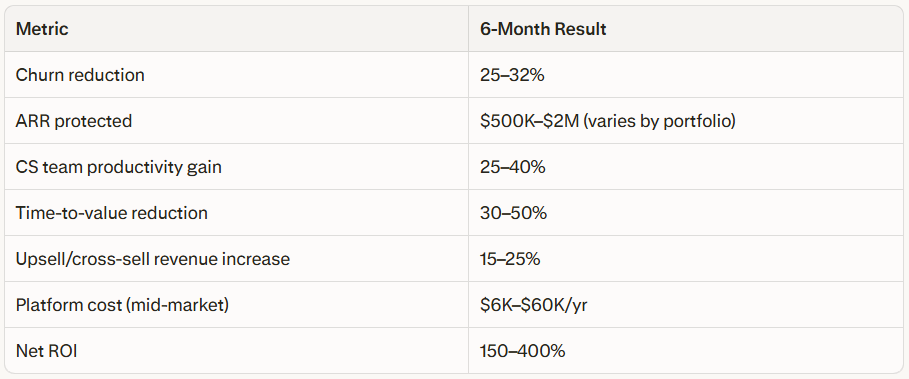
Adoption by day 90 drives outcomes more than vendor choice
Data quality and signal ownership determine health-score accuracy
Save plays need an owner and timeline, not just alerts
The ROI story is compelling, but only if the platform is actually used. The biggest predictor of CSP ROI is adoption within the CS team in the first 90 days, not which platform you chose.
To get there, you need a clean retention health score loaded into your platform from week one: objective, signal-based thresholds that every CSM scores the same way.
Without that foundation, even the best platform produces unreliable data.
And once your scores are clean, bring them into your QBR, where ARR-by-color becomes a boardroom metric, not just a CSM dashboard.
Integration Complexity Matrix
Don’t ask “does it integrate?” Ask “how clean is the data on day one?”
Rate each connection in your own stack:
CRM (Salesforce/HubSpot): contacts, accounts, renewals, opportunity fields
Billing (Stripe/Chargebee): plan, invoice status, renewal dates, ARR
Product data (Segment/warehouse): usage events, feature adoption, logins
Support (Zendesk/Intercom): ticket volume, severity, response time
Data warehouse (Snowflake/BigQuery): history, joins, and reporting speed
If any one of these needs custom work, your “2-week implementation” becomes a quarter.
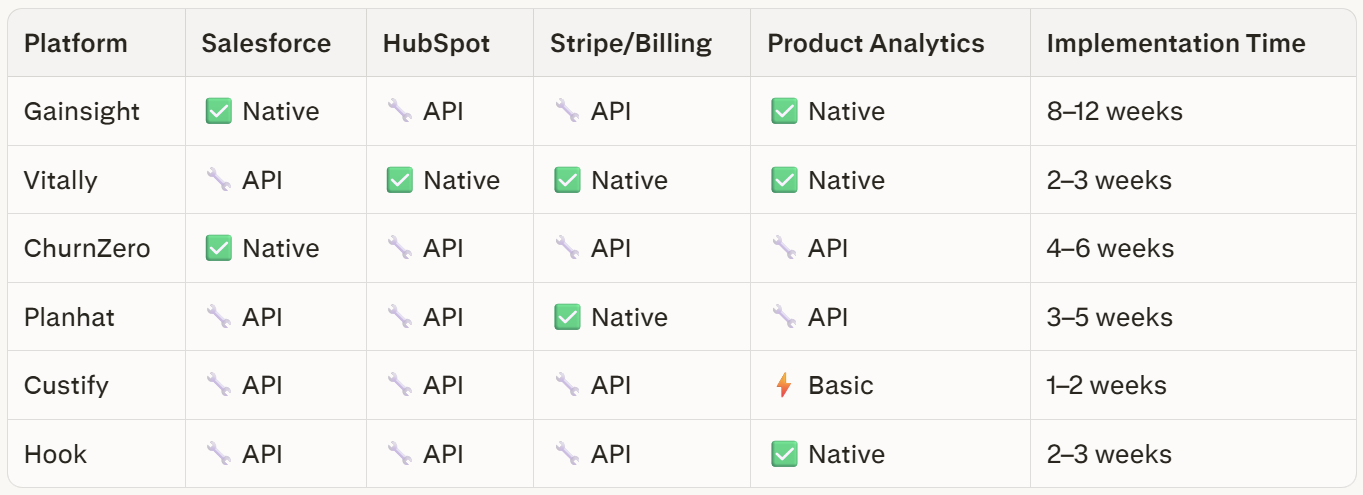
Legend: ✅ Native/pre-built | 🔧 API configuration required | ⚠️ Custom development needed | ⚡ Basic/limited
For more CS frameworks, research, and community resources, the Customer Success Association (customersuccessassociation.com) is the reference library trusted by CS professionals worldwide.
Industry-Specific Recommendations
For SaaS companies — key requirements:
Subscription lifecycle management, product usage analytics, automated renewal workflows, billing system integration (Stripe, Chargebee), and cohort analysis.
One area SaaS CS leaders consistently underestimate: how SaaS price increases interact with health scores. A price increase on a Yellow account is a different playbook than one on a Green.
Best choices: Gainsight (enterprise), Vitally or ChurnZero (mid-market), Custify or Hook (early stage).
For non-SaaS companies — key requirements:
Relationship management over product usage, project-based milestone tracking, and custom engagement workflows.
Best choices: Gainsight or Totango+Catalyst (enterprise), Planhat (mid-market), Custify (small teams).
Frequently Asked Questions
Which customer success platform is best for startups and growing teams?
Growing and early-stage teams have a different shortlist from enterprise buyers, built around speed to live, cost, and adoption.
I cover it in full in the dedicated guide: Best Customer Success Software for Growing SaaS Companies. The short version: Custify for early-stage, Vitally for scaling mid-market.
How much does customer success software cost in 2026?
Pricing ranges from $399/month (Custify) to $100,000+ annually (Gainsight Enterprise).
Mid-market solutions like Vitally ($499/month) and ChurnZero ($1,500/month) offer the strongest value-to-feature ratio for growing companies.
What ROI should I expect from a customer success platform?
Teams that fully deploy and operationalize a platform often see meaningful churn improvement within 6–12 months. Underused platforms deliver close to zero.
The key qualifier is “proper implementation”: platforms that sit underused deliver close to zero ROI.
How long does CSP implementation take?
Vitally and Custify: 2–3 weeks.
ChurnZero: 4–6 weeks.
Gainsight: 8–12 weeks.
Data migration is typically the longest phase, regardless of platform.
Which platform has the best Salesforce integration?
Gainsight, followed by Totango+Catalyst.
If your entire revenue org is on Salesforce and you can’t have a separate integration layer, Gainsight is the only serious option.
Should I use a dedicated CS platform or stay in HubSpot/Salesforce?
If your CS team is under 5 people and your portfolio is under 100 accounts, staying in your CRM is defensible.
Above that, a dedicated CS platform pays for itself in CSM efficiency and early warning signals within 6 months.
What’s new in CS platforms for 2026?
AI-generated health summaries, automated renewal risk scoring, and CS-to-finance ARR dashboards are now standard features in most mid-market platforms, not enterprise-only.
The gap between Gainsight and the rest of the market has narrowed significantly.
Two Ways To Take This Further
You came here to pick a platform. The decision is in front of you. Here are the two paths people take from this point.
Buy the kit (for this procurement)
For the CS leader running a single platform decision and wanting the operating system as files in their hands today.
The CS Platform Buyer’s Kit.
Excel workbook with scoring matrix, RFP bank, demo scorecard, reference check, and full TCO model. 13-page PDF playbook with 10 chapters and 4 email templates. 14 platforms named.
$79. One-time. Yours forever.
→ Get the CS Platform Buyer’s Kit
Join the newsletter (for the whole CS practice)
For the CS leader who runs the whole function and wants the operating systems that keep coming.
The CS Café publishes a new one every week. Renewal plays, QBR cadences, exec dashboards, expansion frameworks. Free to join. Paid subscribers get every workbook and resource bundled in the membership.
After you sign, deployment is its own project. Health score thresholds, QBR storylines, exec reporting, and renewal workflows are bundled into the Ultimate CS Templates Collection.
Vendor note (for platforms): If you build a CS platform and want to be considered for future updates, I run a structured evaluation and inclusion program.
👉 Full details: Vendor Inclusion & Platform Partnerships at The CS Café
For Vendors: How to Be Considered for Future Editions
This guide is updated as the market changes. New platforms enter. Existing players improve or stall.
If you run a Customer Success Platform and want to be evaluated for future editions:
Review the Vendor Partnerships page
Email hakan@thecscafe.com with: company name, what your product does, your ICP and segment, key differentiators, public proof points (G2 rating, analyst coverage), and whether you’re interested in editorial inclusion, sponsorship, or both
Paid Editorial Inclusion funds the work required to evaluate your product in depth. It does not buy rankings, soft treatment, or guaranteed recommendations.
That’s the only way this guide stays useful for the 4,300+ CS leaders who rely on The CS Café to make real decisions about their stack.
— Hakan, Founder of The CS Café